
Three sisters were growing up,
Honest, modest, and fair;
All the village admired them,
The three always together.
They were warned never to forget,
If they wished to be well-spoken of,
To guard their honour carefully
So they might find worthy husbands.
They owned a little humble house
With a low small yard,
A tiny patch of farmland
And one small cow.
The sisters grew into great beauties,
The pride of all the village;
Matchmakers came in waves,
Old women coming and going.
The eldest sister
Was called Elpiniki;
The second one was Veneti,
And the youngest, Aphrodite.
It was the village custom
That the eldest wed first;
So Elpiniki was asked in marriage
By a handsome young man.
A modest engagement followed—
He would take her without a dowry.
Thymios was his name,
He owned a mare and a mule.
For years they stayed engaged;
He came each evening to visit.
They fed him wine and small dishes,
Though oil was scarce and money little.
“If you want a wedding,” said the groom,
“I must also have the field.”
The poor father agreed,
So his daughter would not remain unmarried.
The wedding day drew near—
Here came the groom upon his mare:
“No wedding will take place,” he said,
“Unless I also receive the cow.”
The in-laws accepted as well,
Agreeing to give the cow;
Without the slightest protest
They loaded the mare with dowry gifts.
The whole village gathered
To see the bride;
The priest arrived with holy water
To bless the marriage crowns.
The drums were beating loudly,
And the zournas cried aloud;
The mare was laden with dowry goods,
And the bride walked behind.
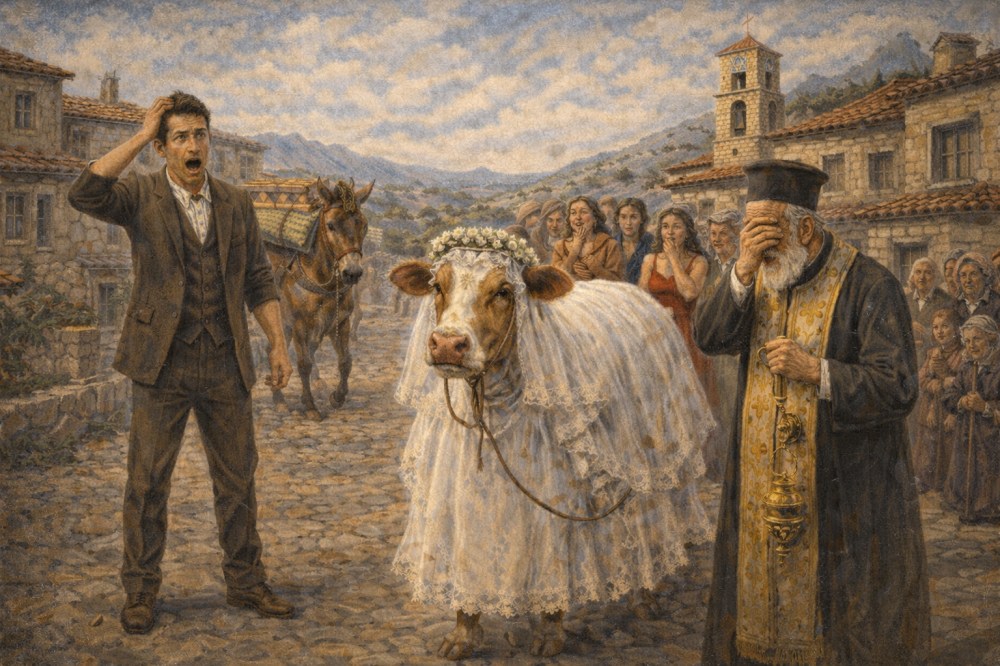
They dressed the little cow
In a bridal gown,
With a white veil upon her head,
Leading her behind the mare.
“Hey! Is this the bride?”
The groom shouted in anger.
“This is not Elpiniki!”
“But such an ox as you are,”
The father cried aloud,
“Such a bride is what you deserve!”
The priest ran off to hide,
Fleeing to save himself—
Never before had he been asked
To marry a four-legged bride.
 Sklithro-Zelenich-Sebalći