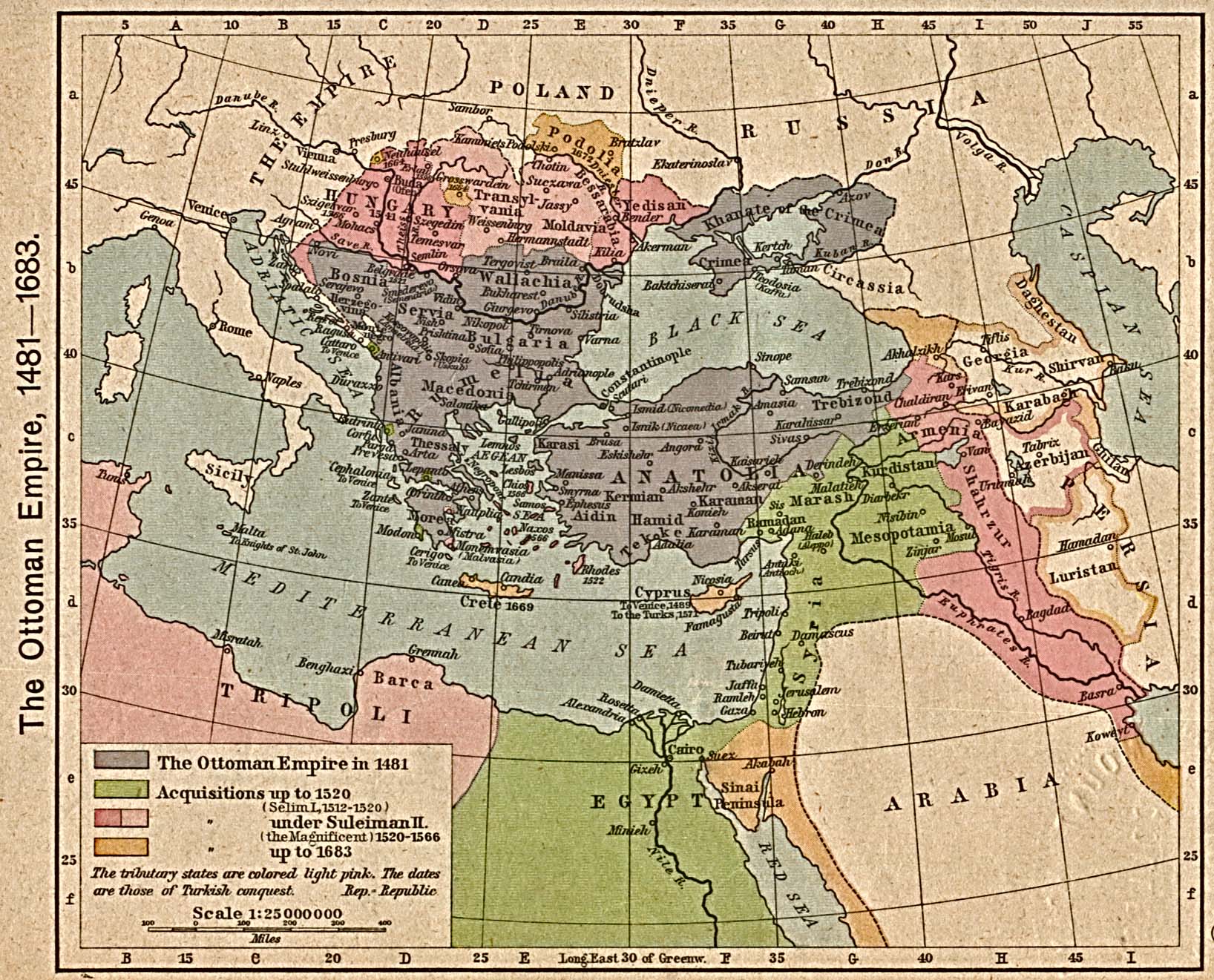

In 1346, the Ottomans under Orhan had made an alliance with John V Cantacuzenus, a claimant to the Eastern Roman empire (Byzantine) throne, and had married John’s daughter, Theodora. This provided the Ottomans with an opportunity to intervene in the domestic problems of Byzantium.

In 1352, Suleyman Orhan’s son (commander of the western frontier) assisted Cantacuzenus in capturing Andrianople from the Serbian and Bulgarian forces. In 1354, Suleymans forces take the fortress of Gallipoli firmly establishing the Ottomans on European soil. This then began a campaign which led to the conquest of Thrace and eventually Macedonia and the rest of the Balkans.
Geographic conditions determined the pattern of Ottoman conquest in the Balkans. They followed the direction of the historic Via Egnatia towards the west, reaching the Albanian coast, by way of Serres, Monastiri (Bitola) and Ohrid.
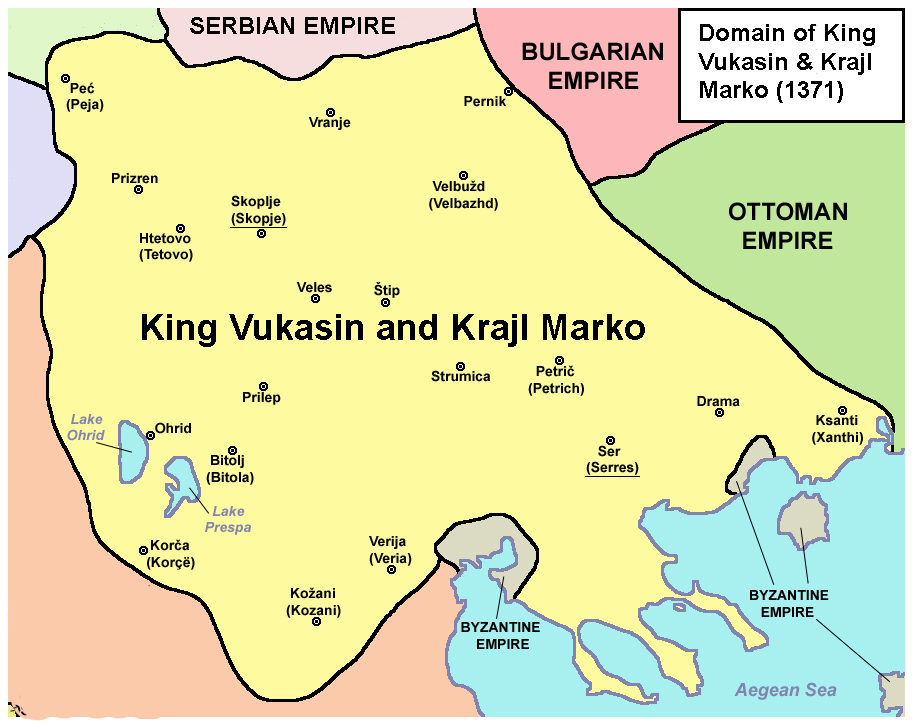
The Ottoman invasion coincided with a time of political fragmentation, when many independent kings, despots and lords ruled independently in their respective provinces without unity or mutual co-operation. The most powerful Vukasin (1366-71) declared himself king of Macedonia and Greece. His rein was short lived as he had to face the advancing Ottoman forces in the Maritsa valley at Chernomen, between Philippopolis and Adrianople, on 26 September in 1371. In a surprise dawn attack, the Ottoman forces won decisively. The Ottoman possessed the military strength and centralized authority and well as the first standing army in Europe, the Janissary corp. The sultan had formed the corp from prisoners of war, after the capture of Adrianople.The Christians suffered extremely heavy losses. Vukasin’s son and successor, Marko Kraljevic, a popular subject of Macedonian folklore, became an Ottoman vassal.
The Ottomans respected the principles of Feudalism. They at first demanded only a small yearly tribute from vassal princes, as a token of their submission to the Islamic state. They later demanded that a vassal prince’s son should be held as hostage, that the prince should come to the Palace once a year to swear allegiance, and that he should send auxiliary troops on the sultan’s campaigns. Vassal princes were required to treat the sultan’s friends and enemies as their own. If the vassal failed in these duties, his lands would again be declared open to the merciless raids of the gazis (warriors fighting on behalf of Islam).
After the Ottoman victory at Maritsa in 1371 over King Vukasin of Macedonia, the other regions began to fall one by one as fortified towns and cities continued to resist Ottoman occupation. The ancient region of Eordai, present day, region of Florina, Kastoria, and Ptolemaida (Lerin, Kostur & Kayjar) was conquered around 1385-1386.
After their conquest, the Ottoman destroyed all the castles in the area. This left the periphery of King Marko’s territory open to raiding by Vlach and Albanian raiders. In the 1390’s large numbers of nomad shephaerd or Yoruks from Asia Minor had settled in Macedonia, especially in the Kayjal-Ptoledaida region.
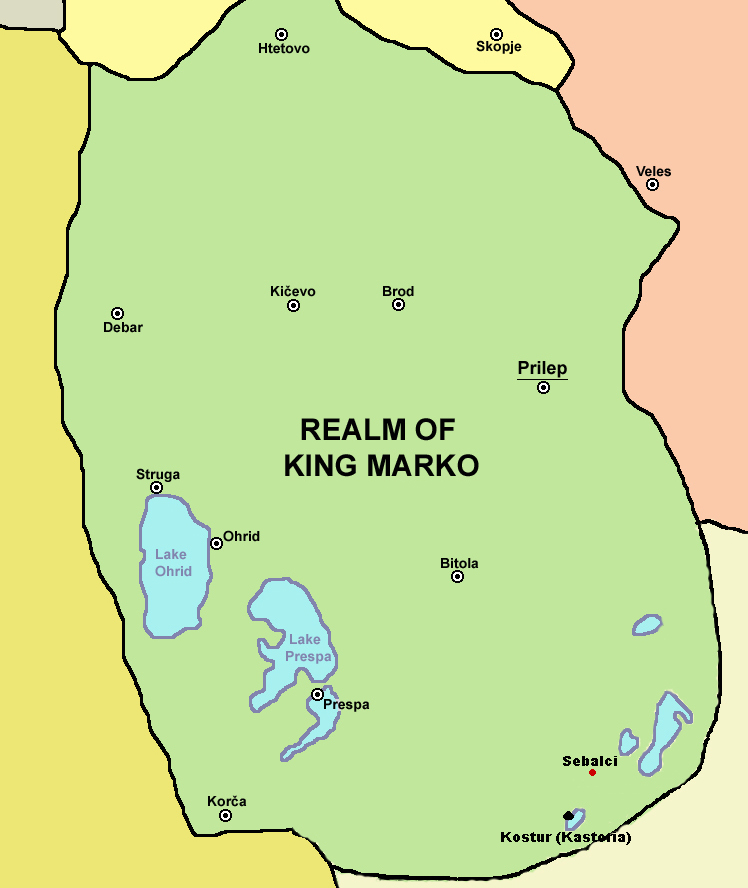
After the rout of the Macedonia Tsar Vukasin at Chermanon in 1371, the Balkan principalities one by one accepted Ottoman suzerainty. By 1377, King Marko (Vukasin’s son) ruled over territory in western Macedonia under Ottoman suzerainty. He funded the construction of the Monastery of Saint Demetrius near Skopje (better known as Marko’s Monastery), which was completed in 1376. Fulfilling his vassal obligation for military assistance to Sultan Bayazit, King Marko was killed on May 17,1395 in Craiova (Romania) during the battle against the Wallachians in the Battle of Rovine. The people could not accept such a destiny for their king and it is at this time that the legend of Krajl Marko began. According to folk tradition, immediately before the battle Marko comprehended his dishonest position and said, “I am saying and begging God to help the Christians, even if I am among the first to die in this”.

King Marko Folklore: A number of intriguing present-day facts make a strong connection to the folklore King Marko, the location, and the inhabitants of former Sebalci.
- The first foundations of houses were at Sebalci, above “Banja” – close to the ancient bath (pool) on the NE side of lake Zazari (the Ottoman burnt the town and the people escaped into the mountains)
- As mentioned in the previous section (Medieval Macedonia 600 C.E. – 1400 C.E.) this is the location of the famous Krajl Marko rocks on the northeast side of lake Zazari – the same location of the original town/village of Sebalci.
- King Marko funded the construction of the Monastery of St. Demetrius near Skopje (better known as Marko’s Monastery). The village has two churches and the older of the two is named St. Demetrius, which is now located in the cemetery. Did the people keep any connection to their past with this name?
- Beside St. Demetrius, there is a 500 year old oak tree. Was the tree planted when the area was first inhabited?
- Why did the inhabitants name their village Zelenic?
- According to oral history, the valley was very green and the Macedonian word for green is “зелен” (Zelen).
- Zelejnik – the sorcerer who applied plots against illnesses and treated by means of grasses. Mysticism and superstition of treating illnesses with suitible medical plants, minerals and animal products was used in medieval Macedonia. Did the valley where Zelenic was located have these medicinal plants?
After the death of King Marko (1395), his state was incorporated by the Turks, perhaps because he had no direct heir. After the establishment of the feudal system in 1397, many of the Seljuk noble families came over from Asia Minor; their descendants may be recognized among the Beys or Muslim landowners around Kayjlar, present day Ptolemaida. The Ottoman Turkish K-Y-A-L-R means -“Rocks”, and the city was the most important district of the Manastır which was the capital of Rumeli in the Ottoman Empire.

According to oral history, during this time the inhabitants of Sebalci did not submit to the Ottoman and from oral history were forced to leave as the Ottoman burned down the town. The inhabitants from the town of Sebalci scattered throughout the surrounding forest in their search for refuge. The map of the castles in Western Macedonia indicates the dates at which those strongholds were taken over by the invading Ottoman. This would indicate why a similar oral history has been passed on by the present inhabitants of Aetos (Ajtos), Agrapidies (Goricko) and Nymfeo (Neveska). Each fled the Ottoman and found shelter in their present-day locations. Soon after, the town/area was then settled by Yoruks who returned to Anatolia 530 years after the exchange treaty which was made since 1923.
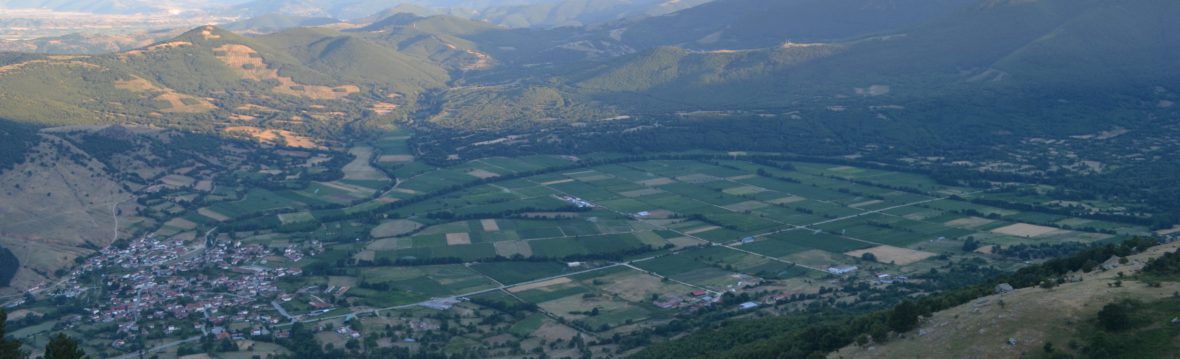
The history of Zelenic is believed to begin sometime between 1385 – 1395, when the first inhabitants fled from the plains around Zazari lake. The inhabitants of Sebalci scattered and took refuge in the dense forests of the surrounding mountains. The villages of Aetos (Ajtos), Agrapidies (Goricko), Nymfeo (Neveska) and Sklithro (Zelenic) were formed thereafter. They remained hidden in these locations for almost 100 years.
The Founding of the Village of Zelenic: After the burning down of the village/town of Sebalci, many families escaped and settled where there was a dense and impenetrable forest. This location was practically inaccessible for the Ottoman as they were more interested in the plains where people lived and not in the mountains. This is why, according to oral history, the elders constantly told villagers to not create any visible signs where they could be noticed. Fires at night were not allowed for fear of being detected. Before the villagers settled in the new location, they believed that if they performed a ceremony, the new settlement would escape destruction, be it by man or natural calamity. The ceremony goes as follows: at the suggestion of some of the older people, two heifer-twins were harnessed and, with their help a furrow was made tracing the boundaries of the new village. Two young boys who were twins led the heifers. It seems that the superstitions belief worked out for Zelenic. Many of the nearby villages were either burnt or destroyed during uprisings or by the calamity of nature, but Zelenic remains intact to this day.

1481 – Tax Register
The first documented evidence appears when all four villages are first mentioned in an Ottoman defter (tax register) of 1481. The majority of the villages in the Macedonian mountain regions came into existence this way. Revolts and uprisings took place and the besieged “reaya” (enslaved population) had to leave their homes, hide in safe places which were in the mountains.
According to the oral history passed on by our grandfathers, when the Ottoman had reached the limit of taxing the Christians in the plains and valleys, their turned to the mountains beside the plains. Aetos (Ajtos), and Agrapidies (Goricko) were first to be registered, and as the Ottoman administrators and soldiers reached Nymfeo (Neveska) at the top of the mountain, they saw smoke in the valley below. They then proceeded to Zelenic (Sklithro) and registered the village as they did with the other villages, so as to increase their sources of revenue from the Christians (Muslims were exempt from taxes).
Some villages had exemptions or lower taxes if they were along the main routes and had the task of constructing and maintaining roads. The village of Nymfeo (Neveska) was originally inhabited by Macedonians who had fled Sebalci (4-5 families). Years later, the village had an influx of Vlachs (Christian nomads of Macedonia) who were exempt from certain taxes in return for service as frontier guards and raiders. The Ottoman usually moved Vlachs on mountain tops to keep an eye on the Macedonians in the valleys below. Since the village was on the mountain top, they acted as frontier guards (policemen) in the area.
As the decades went by, more and more of the land was cleared for farming and by the time Zelenic was discovered by the Ottoman, the valley and people were ripe for being exploited. The valley was soon inundated with most likely wondering Yoruks. The villagers were forced to moved on the western side of the Eleovo (Lehovo) creek. As the Muslims claimed the original site for themselves.
Timar System of Agriculture: The economy of the Ottoman Empire was mainly based on farming using the timar system. The longevity of the Ottoman Empire was mostly dependent on its economic and military systems. Timar was one of these systems that addressed both the economy and the military of the Empire.
It was not possible for the Central Government to manage all the lands owned by the Ottoman Empire. Not only, it would require a lot of organization, but it would also be an inefficient way of working the land. Therefore the government gave (or loaned) land to certain people. These people were called reaya (tax paying subjects) and were expected to work the land and pay a certain amount of their income as tax. This system was used for land in the plains, but land that was in marginal areas that were mountainous and forested were treated differently. As the empire expanded and more revenue was needed, the free and independent people hidden in the forests and mountains were being discovered and government officials began a process of registering these lands as property of the state.
The government began to exchange the right to collect the tax given by the reaya, in return for certain services, preferably military. The people who were given this privilege were Muslims called timariots (timar holders). These tax collectors did not own the land, and the reaya were not their slaves. Instead of land, they owned the rights to collect the taxes, and in exchange for this income, they had to support the army with a number of cavalrymen, called the sipahis. The number of troops they needed to supply depended on the amount of income the timars provided. As a result of this system, the Government was able to efficiently manage the economy, and call upon an army of timarli sipahi’s when needed.
For some reason, according to oral history, the village of Zelenic never had to pay taxes. But this cannot be corroborated and it is our opinion that there may have been some type of exemption due to the mix of Christians and Muslims living peacefully together. By the late 1800’s one third of the population was Muslims and apparently they worked for the Christians and did not posses any land. The introduction of the Ciftlik system (16th & 17th centuries) was avoided by the village. According to oral history, the leaders of the village, both Christian and Muslim, gathered at “Black Water” (Tsrna Voda), the fork in the road that lead to Neveska (Nymfeo). Here the leaders met the Ottoman government officials bearing gifts and lobbying for the exemption from becoming a ciftlik. They convinced the government officials that since both Muslims and Christians lived in peace and harmony they should be exempt from becoming a ciftlik and paying taxes, and they were. The government officials then proceeded to go up the mountain to Neveska (Nymfeo) and made it a ciftlik.
Ciftlik: large agricultural lands organized as a production unit under a single ownership and management and usually producing for market came into being mostly on mawat, i.e., waste or abandoned lands outside the areas under the cift-hane system. A typical ciftlik was small, no more than 2 or 3 units (household units) in size. Although consolidated, large ciftliks existed in export-oriented zones, these were most untypical.
In the last years of the 14th century almost all of Macedonia had fallen under Turkish rule, and in 1408 Turks had taken over the Holy See of the autocephalous Macedonian Apostolic Church. Ohrid found itself under the Turkish yoke. Nevertheless, the Turks respected the Macedonian Holy See and its apostolic Christian authority. And despite this new foreign occupation the Macedonian Apostolic Church expanded its jurisdiction. However it suffered great material damage from the Turks as the the conquest of Macedonia was accompanied by devastation of towns and villages and looting of Christian properties. Due to the displacement of population, episcopacies lost revenue and they got empoverished. There was a massive Islamization of the Macedonians, as whole villages converted to Islam.
The relations between the Macedonian Apostolic Church – Ohrid Archiepiscopacy and the Constantinople Ecumenical Patriarchy worsened in 1439, when the Constantinople Patriarchy entered into a union with the Roman-Catholic church.
Sources:
- Bursa Selanik Göçmenleri. (n.d.). Retrieved from http://www.bursaselanikgocmenleri.com/2015/10/kayalar-ptolemaida_3.htm
- Chulev, B. (2016). THE SIEGE OF SVETIGRAD (‘Saint-city’) 1448/1449. Retrieved from https://www.academia.edu/30367090/THE_SIEGE_OF_SVETIGRAD_Saint-city_1448_1449.jpg
- Esemono. (2008). Retrieved from https://upload.wikimedia.org/wikipedia/commons/9/9f/Rise_and_Fall_of_the_Ottoman_Empire_1300-1923.gif
- Google Maps. (n.d.). Retrieved from https://www.google.com/maps/@40.6389459,21.5278248,14.15z
- Inalcik, H. (1973). The Ottoman Empire: The Classical Age 1300-1660.
- Machado.Retrieved from http://www.reisenett.no/map_collection/historical/shepherd/Ottoman_Empire_1481-1683.jpg
- PANONIAN.Retrieved from http:/https://commons.wikimedia.org/wiki/File:Vukasin_ugljesa_1371_en.png
- PANONIAN.Retrieved from https://en.wikipedia.org/wiki/Vuka%C5%A1in_of_Serbia#/media/File:Vukasin_ugljesa_1371_en.png
- PANONIAN.Retrieved from https://upload.wikimedia.org/wikipedia/commons/4/4a/Central_balkans_1373_1395.png
- Retrieved from https://www.kastra.eu/fndwmcen.php
- Vakalopoulos, A. E. (1973). History of Macedonia, 1354-1833. Thessaloniki: Institute for Balkan Studies.
- WikiZero – Ptolemaida. (n.d.). Retrieved January 21, 2019, from https://www.wikizero.com/en/Ptolemaida
 Sklithro-Zelenich-Sebalći