
During this day and the rest of the month of March people share with their family members and friend’s bracelets made of white and red threads, hemp, woollen or cotton. The bracelet martia is called differently, depending on the country. In Macedonia it’s мартинка (martinka), in Bulgaria – мартеница (martenitsa), in Greece – martis, in Albania – verore and in Romania and Moldova – mărțișor. Mostly, white color symbolizes purity and health and red is symbol of blood and life. There are several other sources saying about white as a symbol of health and longevity and red symbolizing the sun waking up to life after the long winter. The most common saying is that the white and red colours, put together, symbolize simply a wish for good health.
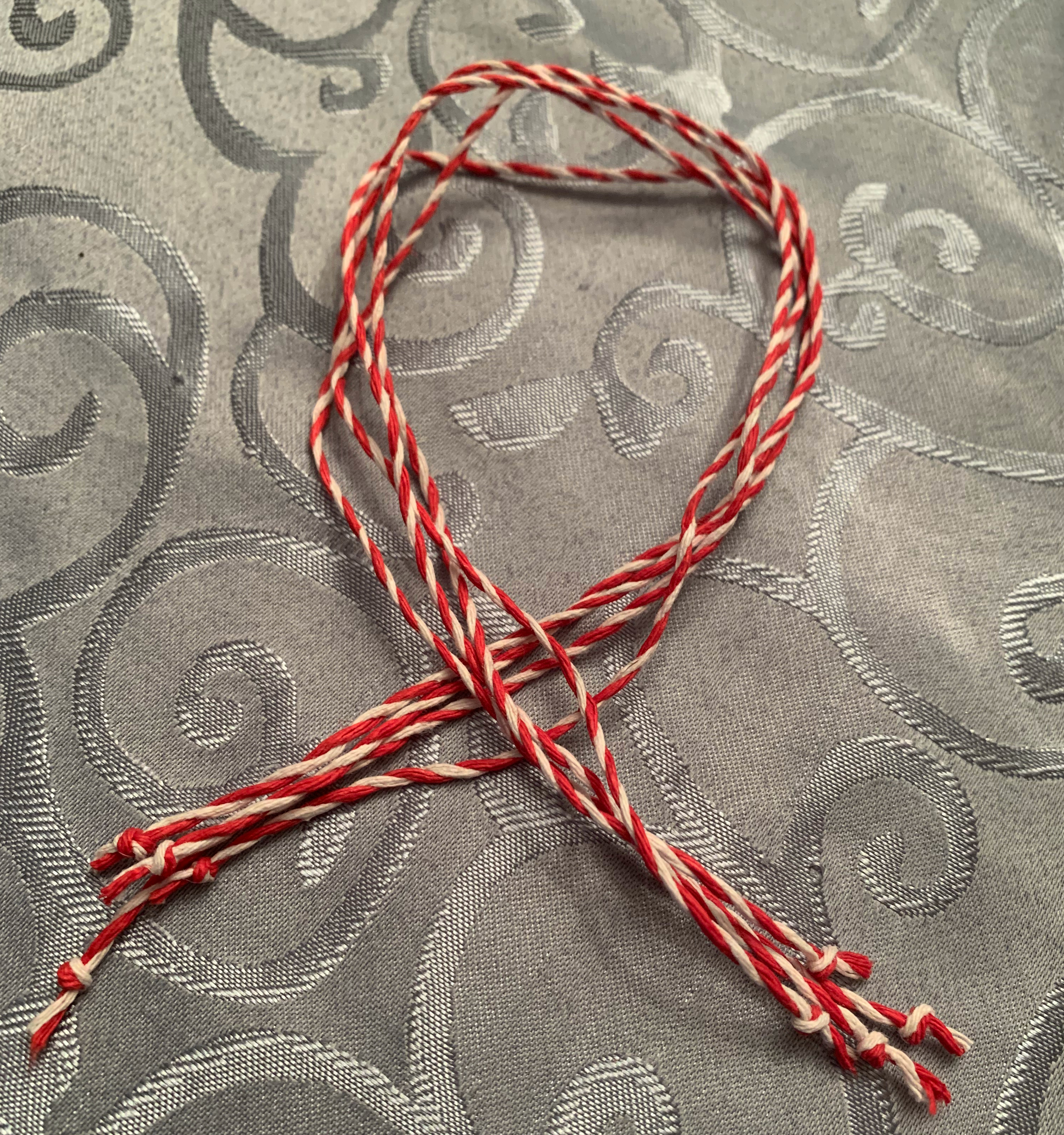


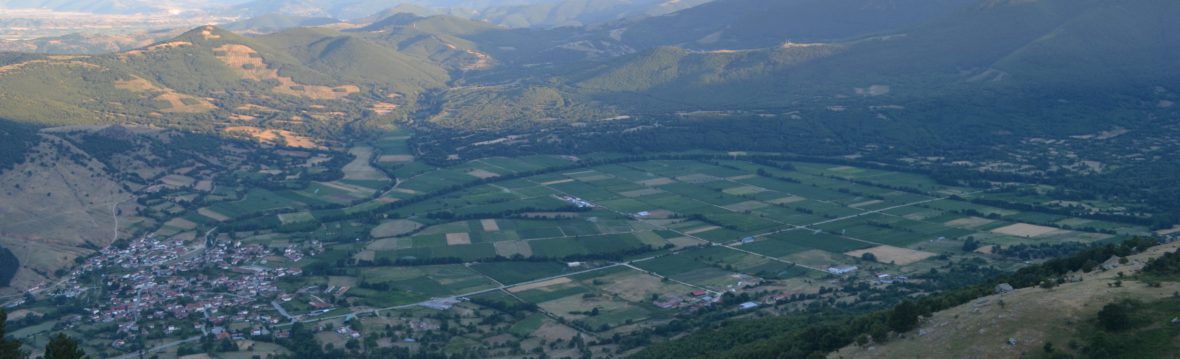
March is synonymous with the coming of spring. It is therefore often associated in many world cultures with social practices, rituals, and festive events that represent rebirth and new life. For centuries the people of the Balkan peninsula have welcomed the first day of spring by wearing the Martinka as it was and is still known in Sklithro- Zelenić as a traditional charm made of red and white thread, worn for protection and good luck.
Most ancient cultures of south-eastern Europe used to welcome the new year on the first day of spring, at the same time as the beginning of the new agrarian year. Symbolically, March came to embody revitalization and a new beginning. Most associate March with its unpredictable weather patterns. This particular feature of the month stimulated folk imagination, and several myths, legends, and traditions are associated with March’s sudden and tempestuous weather changes. This folklore places a strong emphasis on luck and protection against the inherent perils of this transitional period of the year.
Martia is a centuries-old tradition that is practised by most peoples of the Balkan peninsula, although specific features of the ritual may vary across regions and countries.
When we give a martinka to our loved ones, we want to protect them from bad eyes. This is why these woollen bracelets are treated as some kind of amulets. Usually people wear a martinka until they see first sign of spring, which can be the first blooming tree or first stork or swallow. However, some people wear it for the whole month of March.
According to village tradition, as soon as the first sign of spring is seen, what a wearer is suppose to do is to put the martinka on a blooming fruit tree. This would give the tree luck for a fruitful harvest. Birds would also take the thread and use it to reinforce its nest to give it strength and luck for strong offspring.

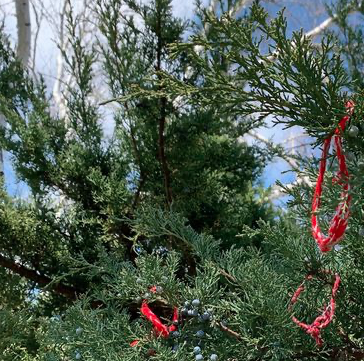
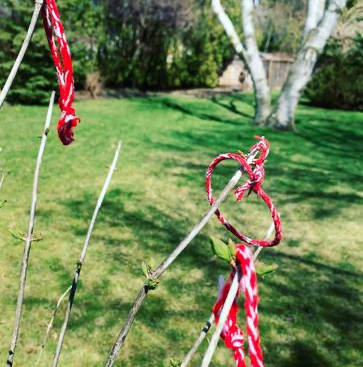
In some places, people would leave the bracelet under a rock which was used for divination. People were coming back after few days to check what appeared there. If there were some kind of insects (as red ants, for example), people interpreted it as a promise that the flock of sheep or horses will increase. Nowadays, people still have tendencies to look for signs under the stones to foretell the future. Appearance of maggots is interpreted as a success, ants tell that there is a success ahead, on which you have to work hard to come, and spiders announce misfortune.
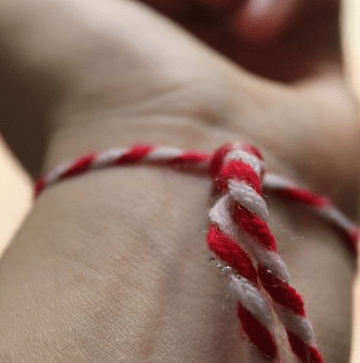
In present-day Sklithro-Zelenić, the Martinka is offered to children on the first day of March, who usually wear it around their wrists or ankles. According to common belief, the thread protects the children from the strong rays of the spring sun. Upon seeing the first swallow that symbolizes the coming of spring, the Martinka is removed and placed on a tree branch, only to be taken by the birds that will use it to build their nest.
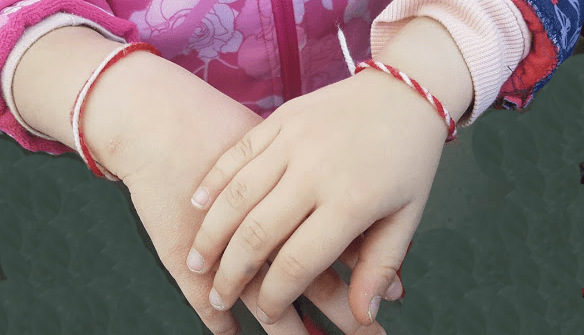
A similar old custom, anchored in pagan practices and agricultural cults of nature, survived in Bulgaria. Bulgarians greet the first day of March, a holiday known as Baba Marta, wearing a collar decoration made of entwined red and white threads, the famous Martenitsa. Most commonly, Martenitsa comes in the form of two small dolls, Pizho and Penda, a white male and red female textile figure. White is associated with strength and purity, while red symbolizes health and fertility.
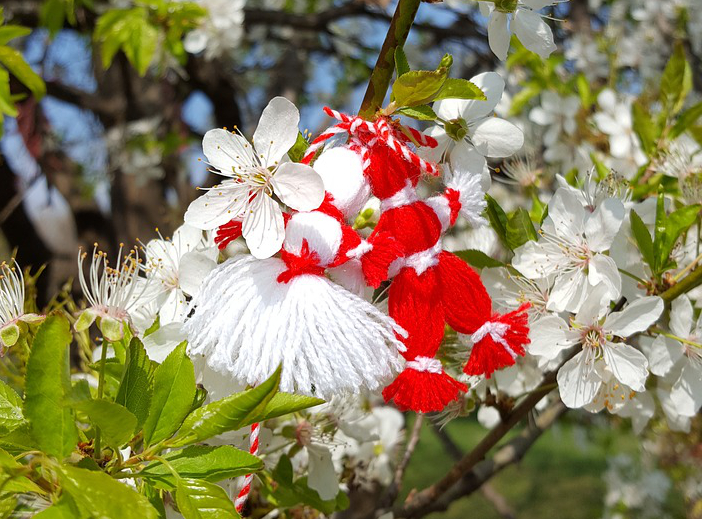
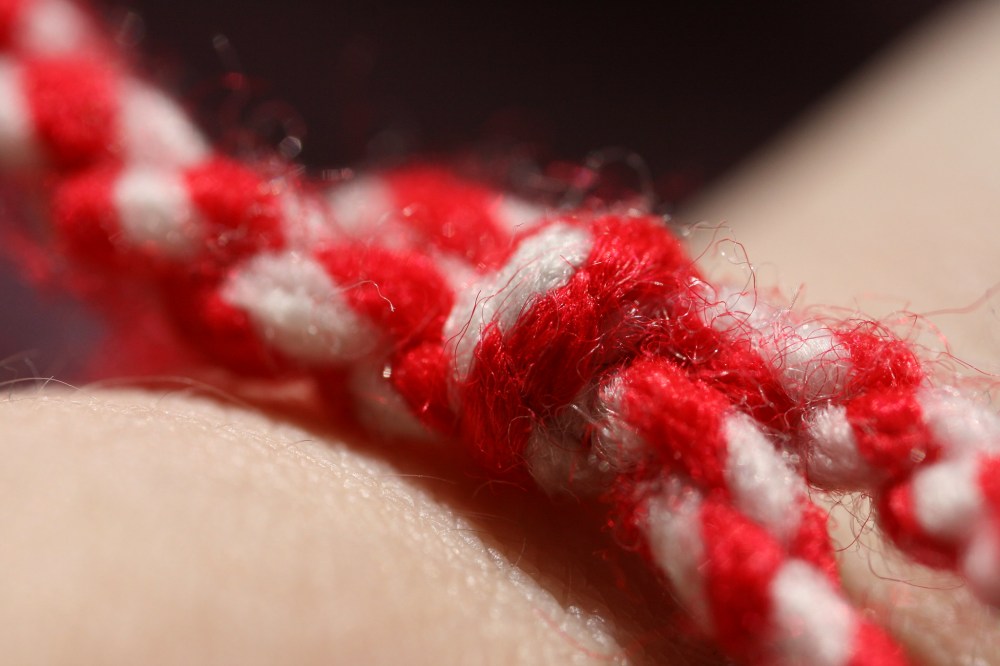
In Romanian and Moldavian tradition, women would fashion a small object of two twisted threads of wool, one red and one white. This Mărţişor is offered to loved ones on the first day of March. The red string symbolizes beauty and the white purity, closely related to the beautiful snowdrop flower that blooms in March. People would put them around their neck, wrist, or ankle, or pin them on their clothes, close to their heart.

In some cases, a Mărţişor would be placed at the house or the stable entrance or around the neck of livestock to protect the household and its owners during the new agrarian year. After the arrival of the first swallow, the artifact would be left on a tree or bush, or be hidden under a stone.
Over the years, the tradition of Martia has greatly inspired traditional craftsmanship and folklore art. At present, the once simple trinket has evolved to incorporate small pieces of jewellery and wooden, leather, and ceramic tokens, as well as a variety of symbols believed to bring good luck and prosperity.
On the initiative of several countries where this fascinating tradition lives on, the custom of Martia and all relevant cultural practices associated to the first of March, were proposed for inclusion in UNESCO’s List of the lntangible Cultural Heritage. Martia is currently under consideration for inclusion in 2015’s representative list.
Sources:
Abbott, G. F. (2011). Macedonian folklore. Cambridge University Press.
Akritidou, M. (2015, March 25). Martia: The Balkan tradition of spring. Culture Trip. https://theculturetrip.com/europe/greece/articles/martia-the-balkan-traditions-of-spring/
Dimitrovska, V. (2016, January 29). Grandma march day, the Balkan tradition of exchanging handmade amulets. Global Voices. https://globalvoices.org/2016/01/29/grandma-march-day-the-balkan-tradition-of-exchanging-handmade-amulets/
Elisaveta. (2017, March 31). Martenitza [Photograph]. pixabay.com. https://pixabay.com/photos/martenitsa-tradition-custom-2213272/
Macedonian Cuisine. (2021, March 1). Martinka [Photograph]. http://www.macedoniancuisine.com/2017/03/martenitsa-for-happiness-and-health.html
Macedonian Cuisine. (2020). Martenitsa for happiness and health (Martinka). WELCOME TO MACEDONIAN CUISINE ~ Macedonian Cuisine. https://www.macedoniancuisine.com/2017/03/martenitsa-for-happiness-and-health.html
Mmalwinkasss. (2014, March 1). Martenica. Moje losy w Bułgarii. https://tymczasemwbulgarii.blogspot.com/2014/03/1-marca-martenica.html
Quinn.anya. (2010, March 18). Macro Martenitza [Photograph]. Creative Commons. https://search.creativecommons.org/photos/4ab32b76-fd95-48a5-b35a-f97133f01c8a
Tahir. (2008, April). Martenitza [Photograph] Creative Commons. https://search.creativecommons.org/photos/f5cf9fa6-3368-4c33-9cc7-f720f7b883a7
Tylor, E. B. (n.d.). Rites and ceremonies. Primitive Culture, Vol 2 (7th ed.), 362-442. https://doi.org/10.1037/13482-007
Voices. (2019, March 20). Share love – share martinka. VOICES. https://voiceskopje.org/2019/03/20/share-love-share-martinka/
Wiekiera K. (2017, March 14). Wiosenny amulet Na szczęście. Pradawny zwyczaj, który przetrwał do dziś. Blowminder. https://www.blowminder.com/2015/03/24/wiosenny-amulet/
 Sklithro-Zelenich-Sebalći