
Koleda is a Macedonian mythological deity, that personalizes the newborn winter infant Sun and impersonates the New Year’s cycle. The twelve days in the year from Koleda (Christmas) to the Celebration of Water (Epiphany) were adopted into the Christian annual cycle where they became associated with the life of Jesus. In these days Jesus had not yet been baptized and his Virgin Mother was still nursing. Christian demons took over the role of the evil force that was believed to be most potent against unbaptized people. In folklore these days are known as unbaptized or Pagan days and believed to be the most dangerous days of the year. They eventually became the start of the Christian 12 Days of Christmas.
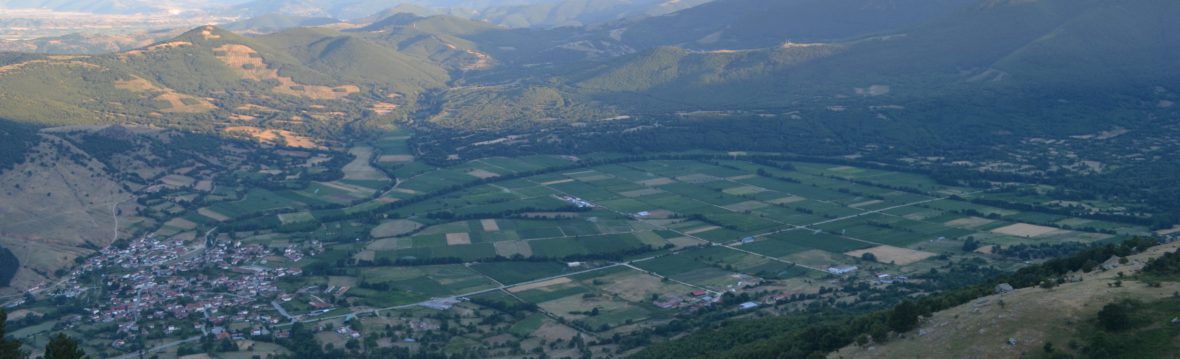
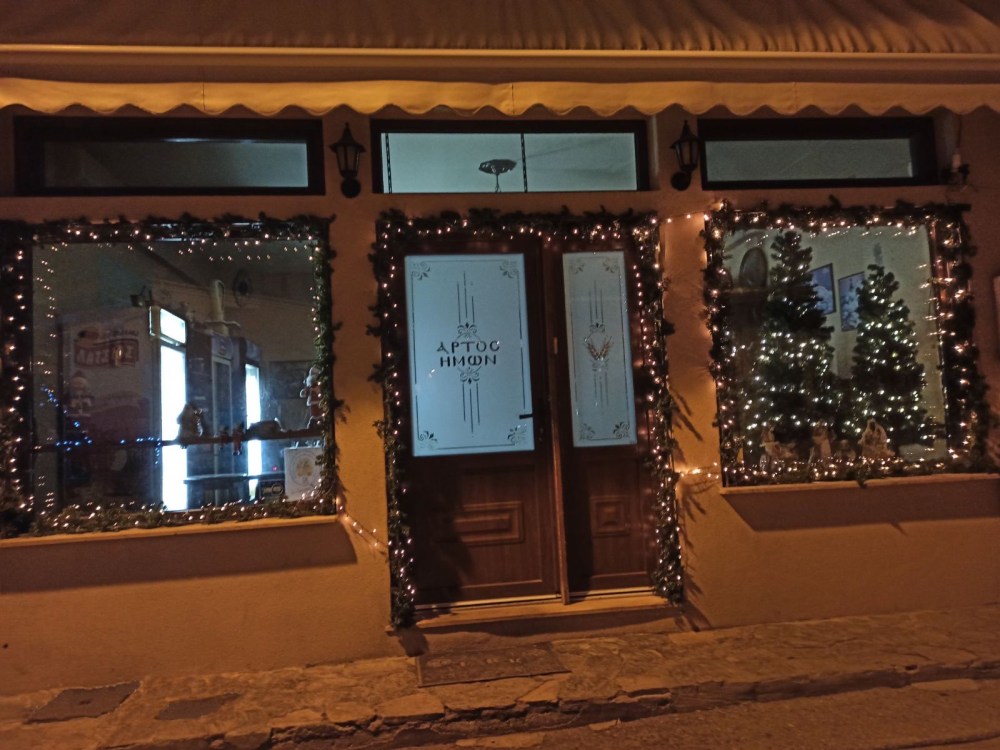
Below are pictures from the village of Sklithro during Christmas of 2020.


Before the 1900s time among the villagers of Zeleniche and of Macedonia was measured not so much by the conventional calendar as by the labours and festivals which coincided with the various seasons of the year. Seed-time, harvest, and vintage; the winter and summer Solstice, and their connection to pagan and religious festivals were some of the landmarks in the life of people in Macedonia and especially the village of Zeleniche.
In most cases the ancient and medieval Macedonian designations of the months have been transformed into forms to which take on modern day influences. These symbolic characteristics continue to illuminate a continuity of traditions, whether it be whole or in part, in the present folk-calendar of the people of the village and region. It shows signs of a highly cultured community with ties to the soil and the climate.
Macedonian winter calendar-ritual customs from KOLEDA (Christmas), ESHKA (New Year’s) to Cleansing with Water (Theophany) are manifested in various forms with fires, songs, dancing and games. In ancient pagan times the sun was the most important deity to people after realizing that their lives depended and were inspired by nature, and the light with which it illuminated the earth. Various cult rituals, especially the sun god was celebrated on certain days of the year. Winter solstice heralded the “new birth of the sun”, with festivities and games, lighting fires, sacrifices and other rituals.

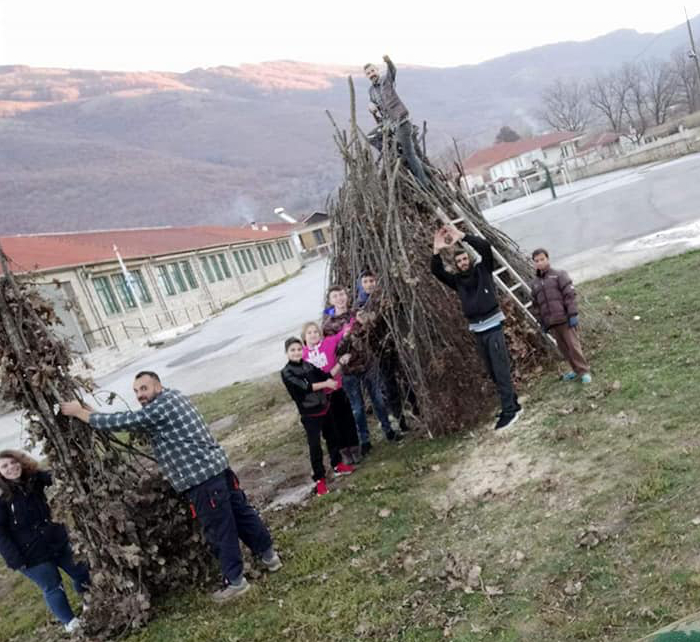

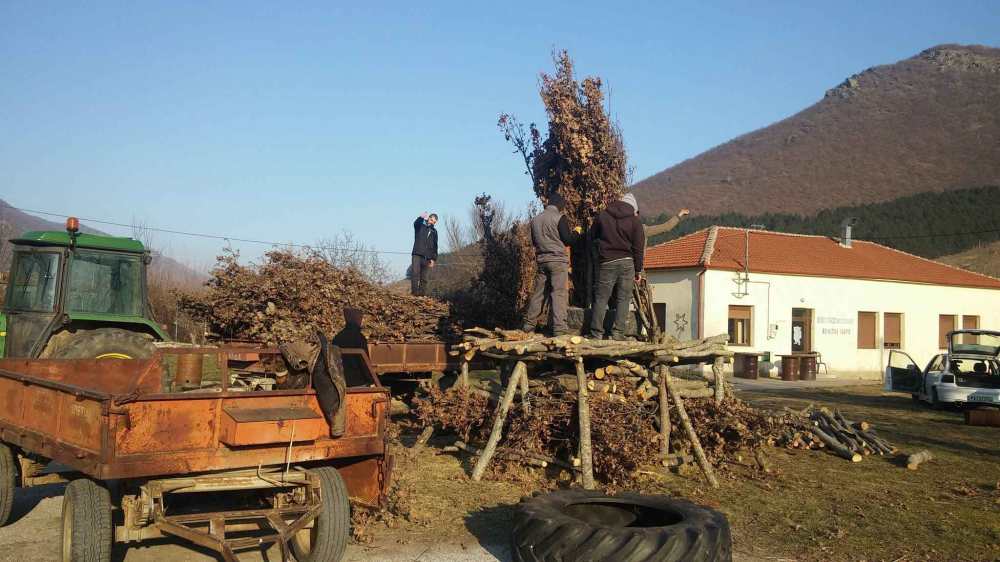
Pictures of building the Koleda bonfire 2019
The Christian religion, from the 4th century on wards, merged the previous pagan festivals for the sun god, with the birth of Christ and began to celebrate it according to the traditional pagan ritual ceremonies for the sun. In our time, numerous elements of the former beliefs and rites in honour of the sun god are preserved in the Christian holiday of Christmas as a celebration of the birth of Christ, to the celebration of St. Basil at new year’s and the baptism of Christ with Theophany. Originally, all Christmas and Theophany (Epiphany for Catholics) celebrations were at the same time (December 25th) but they were separated to coincide with pagan rituals and promote the Christian narrative for the season.
The winter folk celebration of “Koleda” was associated with Christmas as an important holiday in honour of Jesus Christ. The various past customs reveal the roots of the pagan magical-agricultural beliefs and rituals with which the sun was celebrated, but also its connection with the birth of a “young god”, who should bring general prosperity to Christians. In the Christian cycle, the birth and baptism of the “young god” includes numerous motives, which have points of contact but also differences in the approach to the act of birth or baptism and receiving the news of this miraculous event, which begins the history of Christianity.
The Macedonian tradition of KOLEDA in the village and the region of Florina. Every year, on the night of December 23rd, the Macedonians in Sklithro and all across the region gather in the centre of their villages and towns, lighting a giant bonfire to anticipate the birth of Christ. If one were to capture a satellite image of Greece during the night of Dec. 23rd, they would be able to spot all the places inhabited by Macedonians by looking at the bright lights of the bonfires, as this tradition is not celebrated by anyone else in the country.
Koleda (Kalanda in Greek) Koleda is an ancient pre-Christian era of Sun – Light – Fertility – Rebirth celebration. The Macedonian winter festival takes place each year between December 23 and 24 and then continues on New Year’s Eve. It has roots in pagan pyro-worshiping ceremonies which coincide with the winter solstice (December 21), the longest night of the year.
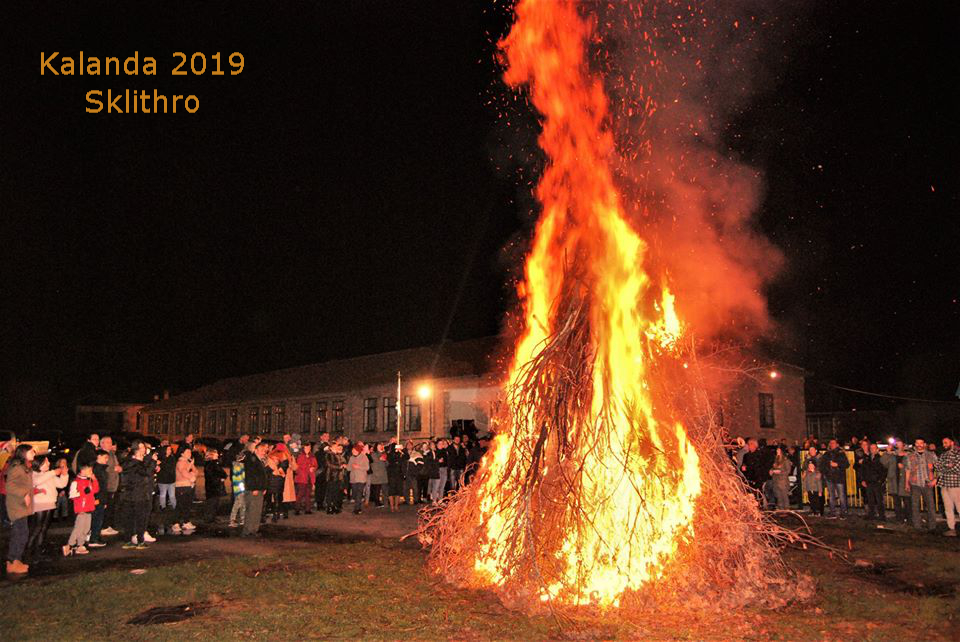
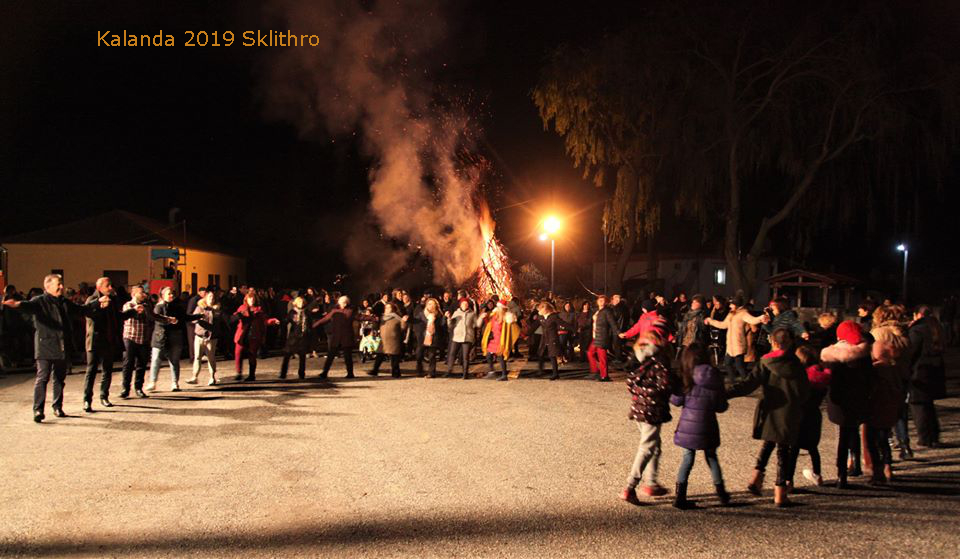
The lighting of large bonfires, at Christmas continues in Sklithro and in many areas of Macedonia (the biggest being in the city of Florina). These customs have survived over time, and they evoke childhood memories and are passed on to new generations as an integral part of the great celebration of cultural tradition. The residents light fires, up to 15 m high and in each of them, they serve bean soup (bop), wine, raki[a], sweets, while around the fire a dance is set up with music by local bands.
Traditionally, in Macedonia during Ottoman times, the family gathered for Christmas Eve dinner. A rich table was prepared exclusively with lean food: pitulici, sarma, beans, potatoes, fish, cabbage, fruits, etc., which would provide a rich crop of crops in the next year. It was customary after dinner not to raise the table, but to stay with the food all night. This has to do with the belief that at night St. Nickolas would come and feed, or in some places, the spirits of the dead.

When the custom was Christianized, it was identified with the fire lit by the shepherds in the manger of Christ and with the announcement of His birth. Christianity has been the official religion of the region for close to 2000 years however, the pagan roots of today’s customs, starting with the name, are clearly visible.
The customs performed on Christmas Eve and Christmas vary from region to region and even from village to village, but what they have in common, of course, with the rich table prepared on Christmas Eve, the Christmas fire and as well as the carol (Koleda) songs.
Traditional carols began the next morning after the bonfires were lit. On the early hours of December 24, before the sun is up, traditionally only the boys would go out and sing carols as they go house to house collecting Koleda bread, chestnuts and if they were lucky a coin for their carolling. From the previous night housewives started their preparations, so that in the morning everything would be ready.

In Sklithro-Zelenić, groups of children were supplied with Kalindarchee, which were thin sticks that a one end had a spherical head with which they knocked on the doors of the houses that they were going to sing Koleda songs. They also had with them backpacks which they hung on their shoulders and in them, they put the treat given to them from each house they visited.
The ritual of the carols has remained to some extent the same from the time of their creation until today. Children roamed around houses singing wishes for the inhabitants of the houses who opened the door of their house, listened to the wishes, and at the end gave some ‘reward’.
- If the one who opens the door accepts, the children sing the carols.
- The song usually begins with a greeting, then announces the event of the next day (birth of Christ, new year, celebration of Santa Claus, baptism of Christ, etc.)
- and ends as then (antiquity) with wishes for the people who hear it.
- After the final song a wish of good luck s given, to which the people of the house respond and then give Koleda bread, chestnuts and if they are lucky, money.
Here is a sample song:
Whoever sleeps, let him get up,
let him knead cookies, if he does not have cookies,
let him give chestnuts, if he does not have chestnuts,
let him give coins …
The boys would also sing a song about Christmas: the birth of a small (young) god, and they would send wishes to the housewife for the well-being of the family.
In addition to the opening and closing phrases of the carols, a number of other features indicate that the ritual of the carols itself is learned and organized informally through oral tradition. Only by listening to and seeing the carols can one learn to say them.
Academics believe that in prehistoric times this day was a holiday associated with the return of the Sun from the southern equator, after the winter solstice. The birth of the new Sun also meant the birth or renewal of life. Later, the Christian Church took this holiday and symbolically associated it with the birth of Christ. To the rebuke that Christians began to celebrate the day of the sun just like the pagans, St. Augustine replied: “We celebrate it not as unbelievers because of the sun, but because of the one who created the sun.”
The symbols of life and fertility, the anticipation and preparation for the arrival of the songwriters, bring with them the youth and power of their symbols, music, and hope and optimism in the face of an uncertain future. Despite the decline and disappearance of many traditional rituals, the carols are still sung to this day, because they signify, no matter how their ritual has evolved, a reassurance of a connection to the past.
Sources:
Abbott, G. F. (2011). Macedonian folklore. Cambridge University Press.
DMWC. (2011, March). Badnikari – Celebrating Christmas Eve. Macedonia Welcome Center – Non-governmental non-profit organisation promoting Macedonian culture including cultural diplomacy in Macedonia and abroad. https://www.dmwc.org.mk/wp-content/uploads/2020/07/badnik.pdf
Ellinismos Online. (2020, February 7). Χριστουγεννιάτικα έθιμα, Μακεδονία. https://www.ellinismosonline.gr/en/tradition/christmas-customs-macedonia
Florina Foties. (2015, December 1). Φλώρινα – Φωτιές (short film) – Florina Fires. YouTube. https://www.youtube.com/watch?t=149&fbclid=IwAR0_PWBGac33yNaD01JVhaShQY4mbc4LAz-W76TIeWHa7iuW8Wyu2mYcqLM&v=pEU7qC23aBM&feature=youtu.be
Florina Past. (2012, December 20). Τα κάλαντα της ΣΤ τάξης του εξατάξιου Γυμνασίου Φλώρινας το 1968. florinapast | Λεύκωμα Φλωρίνης. https://www.florinapast.mysch.gr/ta-kalanta-tis-st-taxis-tou-exataxiou-gymnasiou-florinas-to-1968/
Kimic’s Blog. (2010, January 7). коледарски песни – Koleda Songs. https://kimic.wordpress.com/tag/%D0%BA%D0%BE%D0%BB%D0%B5%D0%B4%D0%B0%D1%80%D1%81%D0%BA%D0%B8-%D0%BF%D0%B5%D1%81%D0%BD%D0%B8/
Murray, J. (1872). A handbook for travellers in Greece: Describing the Ionian Islands, continental Greece, Athens, and the Peloponnesus, the islands of the Ægean sea, Albania, Thessaly, and Macedonia (4th ed.). London J. Murray.
OlaDeka Blog, M. (2017, December 25). Χριστουγεννιάτικα Έθιμα στη Μακεδονία και όλη την Ελλάδα. OlaDeka. https://oladeka.com/2017/12/%CF%87%CF%81%CE%B9%CF%83%CF%84%CE%BF%CF%85%CE%B3%CE%B5%CE%BD%CE%BD%CE%B9%CE%AC%CF%84%CE%B9%CE%BA%CE%B1-%CE%AD%CE%B8%CE%B9%CE%BC%CE%B1-%CF%83%CF%84%CE%B7-%CE%BC%CE%B1%CE%BA%CE%B5%CE%B4%CE%BF%CE%BD/
PameGrevena. (2015, December). Παραδοσιακά Χριστουγεννιάτικα κάλαντα των Γρεβενών! PameGrevena.gr. https://www.pamegrevena.gr/2015/12/kalanta-xristougennon-grevena.html
Roukoudi, I. (2009). The carols of the Twelfth Day: The roots and content of an ongoing ritual. UNIVERSITY OF MACEDONIA ECONOMIC AND SOCIAL SCIENCES DEPARTMENT OF MUSIC SCIENCE AND ART. Thessaloniki.
The Doctor. (2013, December 23). ”Kόλιαντα μπάμπου, κόλιαντα”… Τα παραδοσιακά Χριστουγεννιάτικα κάλαντα του Κωσταραζίου. OlaDeka. https://oladeka.com/2013/12/k_24/ ThingLink. (n.d.). Κάλαντα Χριστουγέννων by Xristina Koutelida. Create unique experiences with interactive images, videos & 360° media — ThingLink. https://www.thinglink.com/scene/1390944852123844609?fbclid=IwAR2IrXoF6686o94loGiHJQDX7myRU-pyY_GPaVAWHpHJj7Sc3pRyaMMrj9o
 Sklithro-Zelenich-Sebalći