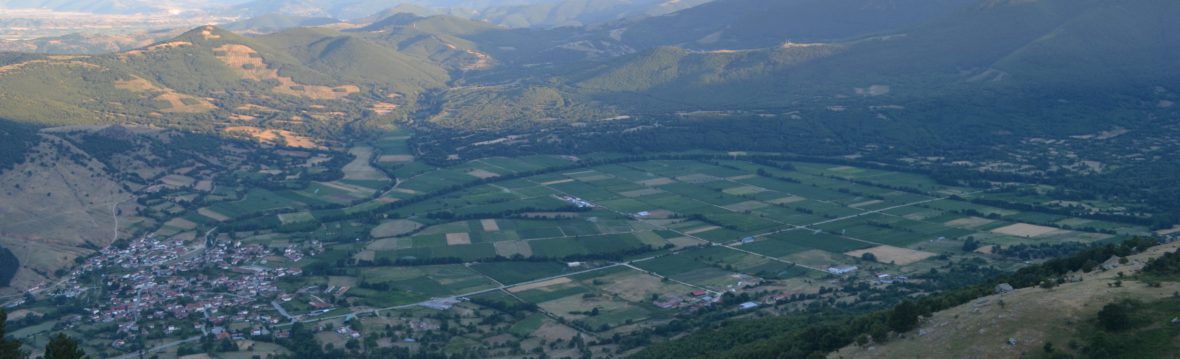

The pagans celebrated spring each year, for more than a thousand years before the birth of Jesus, long before Christianity made its official entrance. They believed that spring was a time of renewal and fertility. It represented new life and the resurrection of nature after the dead of winter. Spring festivals revived various sexual rituals which honoured the sun’s welcoming and warming rays after the cold of winter with its short daylight hours, snow and stormy nights. Spring brought the promise of longer and warmer days which offered life giving forces and much needed warmth.
“The old pagan observances surviving beneath the tolerant cloak of Christianity, the past peeping through the mask of the present.” G.F. Abbott
The importance of the Orthodox clergy in Macedonian history and culture cannot be underestimated. During the centuries under Ottoman domination it was the clergy who maintained a sense of continuity of culture. Often enough the priest was the only literate person in the village, sometimes functioning as a teacher as well.
As is the case among other Balkan peoples, the saints of the Orthodox church appear to have replaced ancient pagan deities and many of the ceremonies of the church can be viewed as a continuation of pagan rites and festivals. Easter is no exception.
The celebration of Easter may still be considered as a continuation of ancient festivities of Dionysus. Women then coloured eggs red, which is considered the colour of life. The Easter festivities are connected with the pagan spring rites, celebrated to ensure fertility of humans, beasts, and fields.
To the people of Zelenich (Orthodox Macedonians) Easter was the greatest celebration of all. The Easter Lent, in Eastern Christianity also called the Great Fast, starts forty days before the Great Week (Holly Week) which is the most important part of Lent. The meaning of the fast is to strengthen spiritually, to enter in a community with God through prayer, good thoughts, righteous deeds and proper way of life.
The fast means abstinence from certain types of food as meat, eggs, dairy products, wine and oil. But beyond food, one has to devote him or herself to intensified prayer, confession, repentance, self-examination and alms-giving. The fast is strict but during some days fish, wine or oil can be permitted. It is interesting that during the Great Lent the liturgical weeks do not start from Sunday but from Monday in order to lead to the greatest Sunday of all, the Easter Sunday.
During the Great Fast a special service book is used in the churches, known as the Lenten Tradition, different from regular liturgy. Another, is that the church increases the prayer for the dead, not only as a reminder to the mortality and penitence, but also to remember intensively the departed. This is why there are three Saturdays during the fast dedicated to the commemoration of the dead.
Palm Sunday

The Feast “Palm Sunday” commemorates Jesus’s entry into Jerusalem, when palm branches were spread before His path by those who welcomed Him in Jerusalem a week before His crucifixion (see John 12:13). The palm is a symbol of triumph and rejoicing. Though most churches today use palms, in earlier times, in lands where palm branches were difficult to obtain, other branches were substituted with the willow in the Balkans. Today too, we attach willow twigs to icons and doors, and churches are crowded on Palm Sunday.

Pussy willows are used throughout northern and eastern Europe to mark Palm Sunday. Besides the obvious fact that there are not a lot of palm trees growing in the Balkans, and because the pussy willow is one of the first plants to bloom in the spring means that it has come to symbolize new life and resurrection. The willow has bivalent symbolism, and its branches are blessed in church on Palm Sunday to bring health and to protect the family. This was just another way that different cultures use to tell the stories of Jesus Christ.
Palm Sunday also known as flowering Sunday or Ćvetnića (Tsvetnitsa in Macedonian) arrives from the word “cvet” (tsvet meaning flower). Around the world, flowers have long played a prominent role in the celebration of this day, with blossoms blessed and intertwined with the palm or other tree branches. So, in some nations of Eastern Europe, it has also been known as Flower or Blossom Sunday. In Sklithro-Zelenich in the past (100 years ago), young brides and girls used to walk with baskets in their hands and go for a walk in the meadows and pick flowers which were then strewn around the churchyard to celebrate the day. They made colorful bunches of flowers as there were members in their family. They also made one more bunch for the home which they would leave at the house icon after returning home. The feast was known as “Flower’s Day” (Tsvetnitsa). Women with names derived from flowers (such as Rosa, Violeta, or Lilia) considered it their name day.
Maundy Thursday
In the early morning of Maundy Thursday eggs are dyed in red, symbolizing victory and coming happiness in the resurrection. Resurrecting, Jesus Christ actually defeated death. The red color represents god’s might and strength. The color of the Easter eggs reminds us of the blood Jesus shed on the cross. In the village the first egg to be dyed was put aside and called “Protector of the House” (Chuvarsko jajche). It was placed beside the family icon and saved until the next Easter (Macedonian custom).
On this day children of the village would travel to the mountains below St. Friday (Sveta Petka – Agia Paraskevi) and to the south-eastern side of Gradishta to collect yellow daffodil like flowers called “grotvets” to adorn the church Epitaph called “Plashchanitsa.” On “Good Friday” parishioners would crawl under the epitaph in the form of a cross.
Kozinjak -Tsourekia
The official celebrations began on Maundy Thursday when housewives dye eggs in red (the colour of Jesus’s blood) early in the morning before sunrise and preparations for the night of making Easter bread after church at midnight on Thursday. This day was also marked with a red cloth, symbolizing the blood of Christ, spread on the balcony or the window.
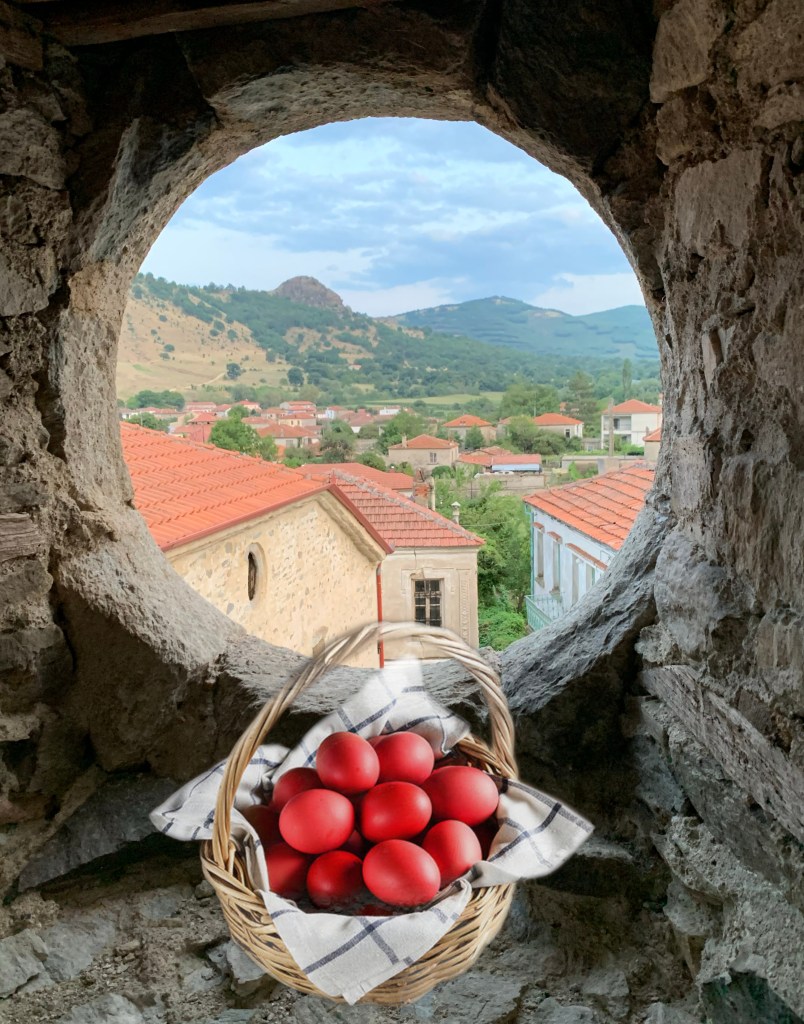
Before going to church on the night of Maundy Thursday grandmother would get the yeast started. Villagers then went to church as they do today to listen to the reading of the ‘Twelve Gospels.’ After church service (12 midnight), she would begin preparing the dough for the Easter bread. The whole process took six hours and in between she would try to catch some naps with the rising of the dough after each stage of production. The final process was the braiding of the dough and placement into pans for the last 2 hours of rising. Braids and knots come from pagan times as symbols to ward off evil spirits. By 6 am the dough was almost ready, just one last step, the brushing of the dough with egg yolks and the sprinkling of sesame seeds and “Boopata” into the oven.
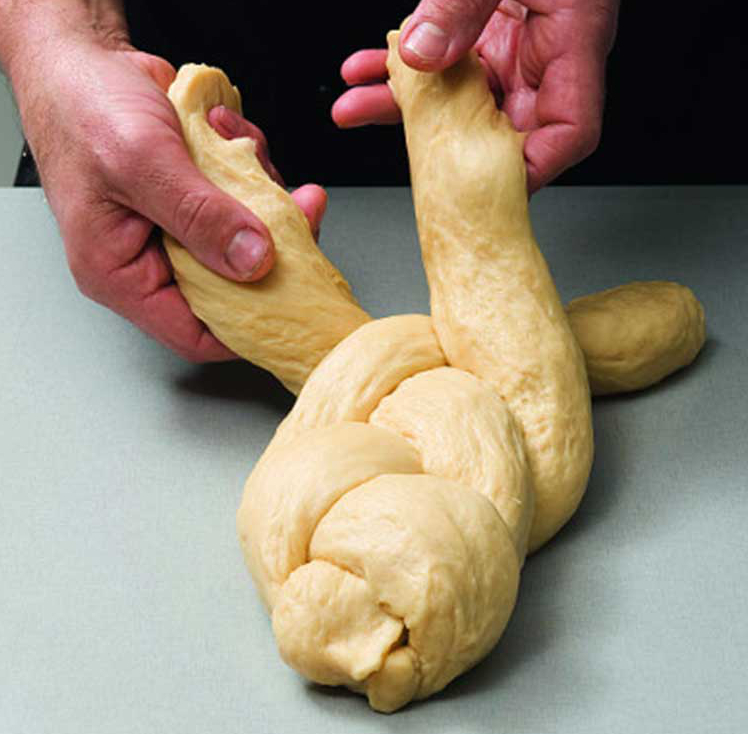


The traditional Macedonian name for Easter bread is “Kozinjak” but, because of the Muslim influence in the village they used “Churek” and in Greek ‘Tsoureki.” Apparently, the name ‘tsoureki’ comes from the Turkish word “Ćurek” which refers to any bread made with yeast-containing dough. The bun symbolizes the Resurrection of Christ as the flour “comes to life” and “transforms” into the “Bread of life.”
Flower Arrangements for the Funeral Bier
On Maundy Thursday children of the village would travel to the mountains below St. Friday (Sveta Petka – Agia Paraskevi) and to the south-eastern side of Gradishta to collect yellow daffodil like flowers called “grotvets” to adorn the church Epitaph called “Plashchanitsa.” On “Good Friday” parishioners would crawl under the epitaph in the form of a cross.
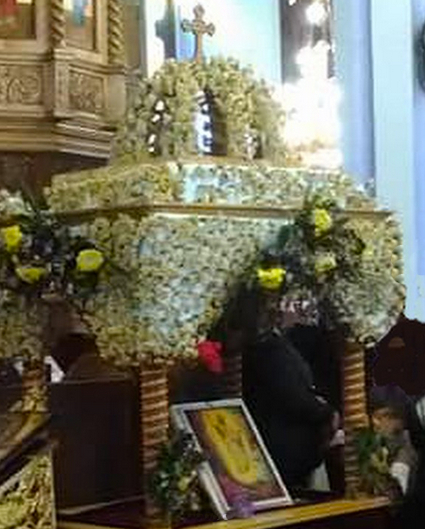
The Epitaph called “Plashchanitsa” in the indigenous Macedonian language is an empty, platform-like area within the flower-covered bier, an arrangement that symbolizes the crucified Jesus laid out on a stretcher. A lavishly embroidered cloth or icon that contains the image of the crucified Christ, and the Bier which resembles a small church.

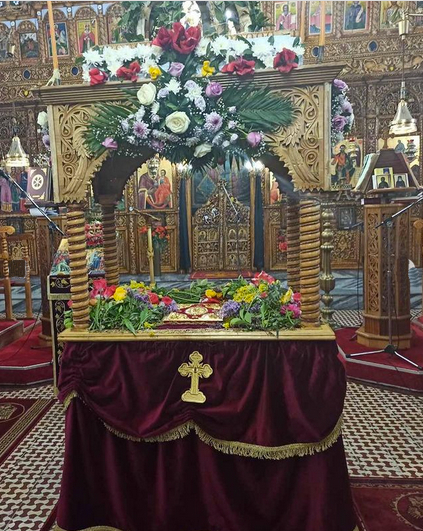

Young girls and women painstakingly position fresh flowers into a wooden bier that serves as the Epitaph, symbolizing the tomb of Jesus. They work until late on Holy Thursday, listening to hymns while creating wreaths, flower chains and exquisite floral arrangements. Once the Epitaph is ready, an icon of Jesus Christ is placed in the middle to symbolize his dead body.
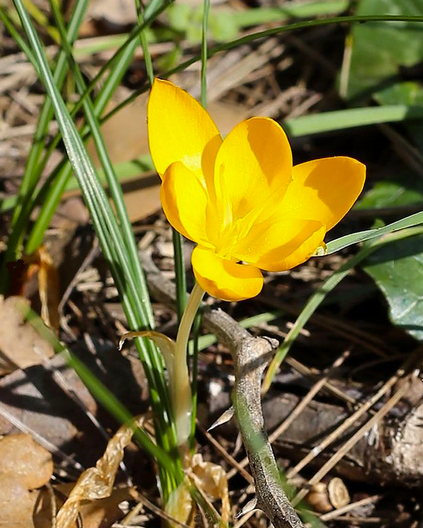
On Good Friday, a mournful day that commemorates the Passion of Christ, parishioners visit the Epitaph, and either kiss the icon or crawl under the Epitaph as a sign of faith and humility. At home only essential duties are performed and the family observes a strict vegetarian fast, even fish and oils are omitted from the menu.

On Saturday, the day of resurrection, one was not allowed to eat all day. Late in the evening the villagers would gather outside St. George’s church carrying with them unlit candles. At midnight the priest would announce the resurrection of Christ declaring “Hristos voskrese”, Christ has risen, then the people replied “voistina voskrese” truly risen, and he let the people light their candles from the Holly Flame taken from Christ’s nativity cave in Jerusalem. After resurrection a church service would take place and once this was over people would go home for a meal, trying to keep the flame alive.

On Easter Sunday, after attending the mass at church, friends and families would gather at their homes celebrating Christ’s resurrection, eating lambs (Christ’s body) and red eggs (Christ’s blood). Before the red eggs are eaten, one must crack them against their neighbours, and whoever wins by having a whole egg at the end will get all the luck. As a kid, we played a game where, if your egg cracked, you had to give it to the winner. At the end the champion was the one who had cracked the most eggs.

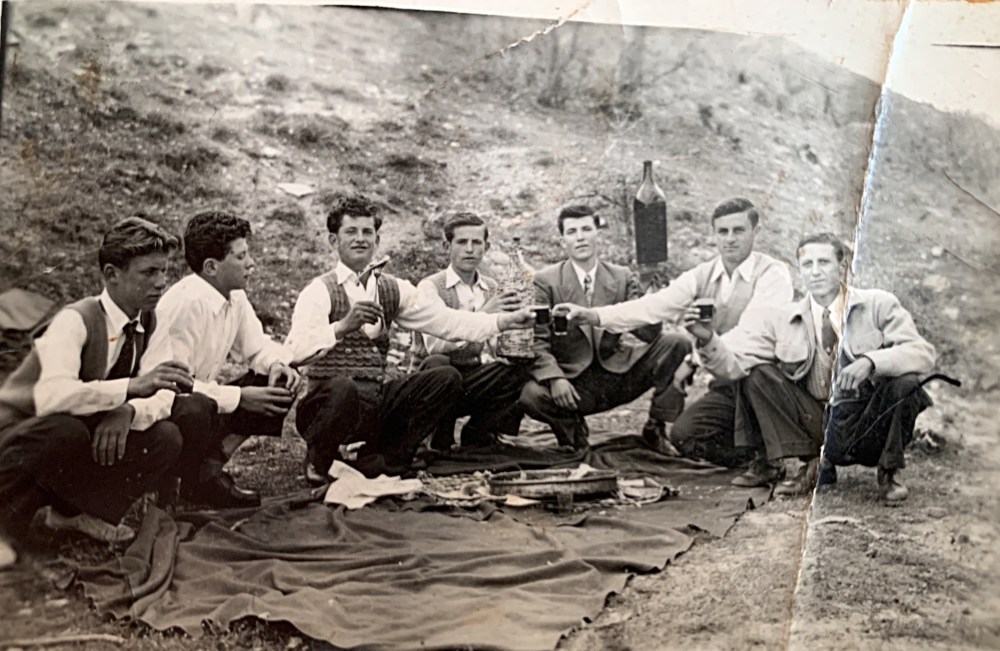
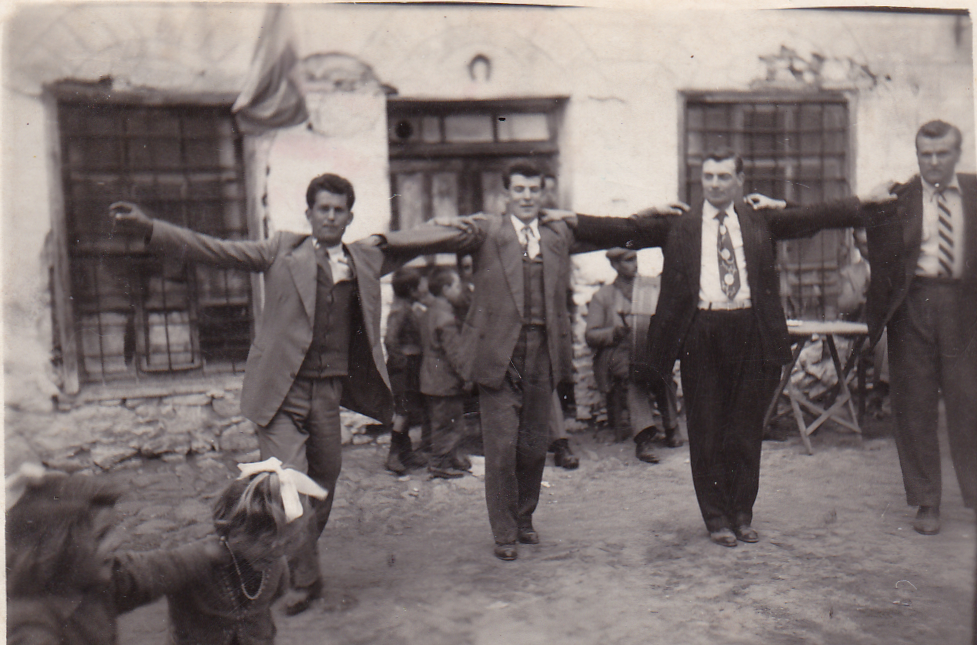
“On the first and second day of Easter, after noontime, the whole village would ascended to the edge of the village, at the foot of Grantista, to the green “Rido”. Family members, friends, amphitheatrists, enjoyed the divine music of “Gubura” (Tasos Valkanis), cracked eggs, drank beers and soft drinks and caressed with interest the young people who danced. When it got dark, the party would take place in the main square, and later the newlyweds would usually enter Thanassis’ cafe to continue the party.” 1960s
Sources:
Abbott, G. F. (2011). Macedonian folklore. Cambridge University Press.
Admin. (2021, April 28). ΤΙ ΣΥΜΒΟΛΙΖΟΥΝ ΤΑ ΤΣΟΥΡΕΚΙΑ ΚΑΙ ΤΑ ΚΟΚΚΙΝΑ ΑΒΓΑ. Dionolymposguide. https://dionolymposguide.gr/%CF%84%CE%B9-%CF%83%CF%85%CE%BC%CE%B2%CE%BF%CE%BB%CE%B9%CE%B6%CE%BF%CF%85%CE%BD-%CF%84%CE%B1-%CF%84%CF%83%CE%BF%CF%85%CF%81%CE%B5%CE%BA%CE%B9%CE%B1-%CE%BA%CE%B1%CE%B9-%CF%84%CE%B1-%CE%BA%CE%BF%CE%BA/
Baba Tala. (2013, May 5). Macedonian sweet bread (Kozinjak). Village Feast – free traditional family recipes. https://www.villagefeast.com.au/2011/04/23/macedonian-sweet-bread-kozinjak/
Boettcher, K. (2015, March 25). 5 theories on why we dye eggs for easter. Mental Floss. https://www.mentalfloss.com/article/49566/5-theories-about-why-we-dye-eggs-easter
Easter in Macedonia. (2014, April 17). My Guide Macedonia. https://www.myguidemacedonia.com/travel-articles/easter-in-macedonia
The feast day of Sveta Petka: The “Saint Friday” of Eastern Orthodoxy. (2017, October 27). amor et mortem. https://amoretmortem.wordpress.com/2017/10/27/the-feast-day-of-sveta-petka-the-saint-friday-of-eastern-orthodoxy/
Gogos, D. K. (2018, March 3). Apokries – Carnival through the ages | Neos Kosmos. NEOS KOSMOS. https://neoskosmos.com/en/28610/apokries-carnival-through-the-ages/
Konstantina. (2021, March 31). Πάσχα και Μεγάλη Εβδομάδα: Έθιμα και Συμβολισμός. TrikalaView. https://trikalaview.gr/pascha-ke-megali-evdomada-ethima-ke-symvolismos-4/
Lauren. (2020, April 29). Macedonian/Greek easter bread: Recipe. The City Lane. https://thecitylane.com/macedonian-greek-easter-bread-recipe/
Macedonian orthodox easter traditions. (2016, October 11). I am Macedonian. https://iammacedonian.com/2017/04/15/macedonian-orthodox-easter-traditions/
McDougall, H. (2010, April 2). The Pagan roots of easter. the Guardian. https://www.theguardian.com/commentisfree/belief/2010/apr/03/easter-pagan-symbolism
My Guide Macedonia. (2012). [Photograph]. My Guide Macedonia. https://www.myguidemacedonia.com/travel-articles/easter-in-macedonia
Rachel. (2015, April 13). Happy orthodox easter! When Life Finds You in Macedonia… https://rvonhollepcmacedonia.weebly.com/blog/happy-orthodox-easter
Religious and expressive culture – Slav macedonians. (n.d.). World Culture Encyclopedia. https://www.everyculture.com/Europe/Slav-Macedonians-Religious-and-Expressive-Culture.html#ixzz6IzAzCW8W
Religious and expressive culture – Slav macedonians. (n.d.). World Culture Encyclopedia. https://www.everyculture.com/Europe/Slav-Macedonians-Religious-and-Expressive-Culture.html#ixzz6IzBALOEI
Religious and expressive culture – Slav macedonians. (n.d.). World Culture Encyclopedia. https://www.everyculture.com/Europe/Slav-Macedonians-Religious-and-Expressive-Culture.html
Religious and expressive culture – Slav macedonians. (n.d.). World Culture Encyclopedia. https://www.everyculture.com/Europe/Slav-Macedonians-Religious-and-Expressive-Culture.html#ixzz6r7XHAfFO
Robert & Susan. (n.d.). Easter and Pagan spring traditions. The entrance door of Home2b. https://www.home2b.nl/susan-office-easter-pagan.html
ΔΟΝΑΚΗΕΠΟΠΤΡΙΑ, Σ. (2020). ΙΣΤΟΡΙΚΗ ΕΡΕΥΝΑ ME ΣΥΝΕΝΤΕΥΞΕΙΣ ΣΤΟΥΣ ΛΟΦΟΥΣ ΤΗΣ ΦΛΩΡΙΝΑΣ.
Ξεχωριστά τα έθιμα της Μεγάλης Εβδομάδας σε κάθε γωνιά της Ελλάδας | Neos Kosmos. (2018, April 1). ΝΕΟΣ ΚΟΣΜΟΣ. https://neoskosmos.com/el/186273/ksechorista-ta-ethima-tis-megalis-evdomadas-se-kathe-gonia-tis-elladas/
Σκλήθρο: Το θαύμα της ανευρέσεως της εικόνας της Ζωοδόχου Πηγής. (2020, April 24). LehovoNEWS24.gr. https://www.lehovonews24.gr/sklithro-to-thavma-tis-anevreseos-tis-ikonas-tis-zoodochou-pigis/
 Sklithro-Zelenich-Sebalći