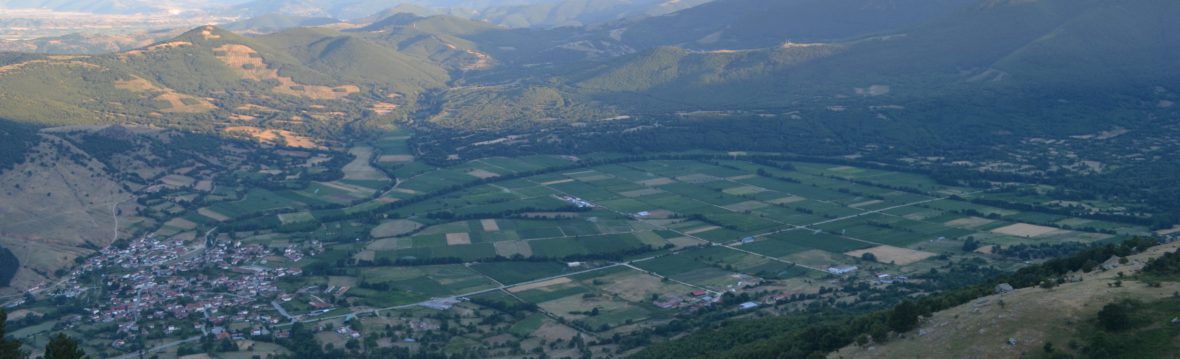

The life and public legacy of Christos Sartzetakis cannot be understood without confronting the unresolved and often deliberately obscured history of Zelenich (modern Sklithro)—a village in Western Macedonia whose early twentieth-century experience was shaped by massacre, coercion, fear, and enforced assimilation.
Sartzetakis is frequently presented as a figure of moral rectitude: a jurist who resisted political pressure during the investigation into the assassination of Grigoris Lambrakis and who later suffered dismissal under the military dictatorship. Yet this image collapses when placed alongside his own writings, which consistently legitimize state violence and erase the persecution of entire populations—including the Macedonian community from which his own mother came.
Zelenich and the Bloody Wedding (1904)
In November 1904, Zelenich became the site of one of the most traumatic events in its history: the Bloody Wedding. During a wedding celebration, Greek armed bands entered the village and carried out a coordinated massacre of civilians.
Crucially, the attack was not spontaneous. Participants themselves later described it as planned and deliberate. In his memoirs, Georgios Karavitis, a member of the attacking group, recounts:
“I directed my rifle low and as horizontally as possible, so as to strike more bodies. In the brief flash of each shot, the bodies appeared like a many-limbed creature writhing in its blood.”¹
Another participant, Pavlos Gyparis, likened the attack to predation:
“They tried to flee, but everywhere they encountered the black barrels of Greek rifles.”²
Eyewitness accounts agree that civilians—men and women alike—were killed inside the wedding house, followed by looting and intimidation throughout the village. Ottoman forces stationed nearby did not intervene.
European observers were unequivocal. The Austro-Hungarian consul reported:
“From Neveska to Zelenich is a half-hour distance. Around 200 shots were fired. The military detachment remained inactive and visited the village only the following day.”³
Modern historiography identifies the Bloody Wedding of Zelenich as one of the earliest mass civilian massacres carried out by Greek armed bands in Macedonia, marking a shift from targeted violence to collective punishment.
Terror as Policy, Silence as Survival
The massacre must be understood within a wider system of intimidation. Armed bands, informant networks, and selective terror were used to break community cohesion and enforce political and national allegiance.
As Dimitris Lithoxou notes:
“The so-called Macedonian Struggle was, in practice, a systematic effort by the Greek state to crush the local Macedonian autonomous movement through terror, collaboration with Ottoman authorities, and the forced assimilation of the population.”⁴
In such conditions, silence was not merely imposed—it became a survival strategy.
Family Ties and Historical Proximity
This history is not distant from Sartzetakis himself. His mother was a native Macedonian woman from Zelenich, whose first language was Macedonian. She was a child at the time of the Bloody Wedding and grew up within a community traumatized by violence and fear.
Local oral testimony recorded by Kostas Kleidis, citing the villager Dimitris Gogos, recalls the context of her later marriage to a Cretan gendarme:
“He said, ‘I will take a woman from here to end the hatred.’ He took her with his pistol. Half the village rose up and said, ‘Didn’t the Cretans slaughter us—now they take our women too?’”⁵
Such marriages were widely perceived not simply as personal unions, but as mechanisms of forced reconciliation and assimilation following terror.
At the same time, archival material identifies local collaborators. Pantelis Oikonomou documents the role of village informants:
“The National Committee of Sklithro included teachers, priests, and villagers who served as guides and informants for the armed bands.”⁶
This places Sartzetakis genealogically between victims and facilitators of violence.
Sartzetakis’ Memoirs and the Erasure of Experience
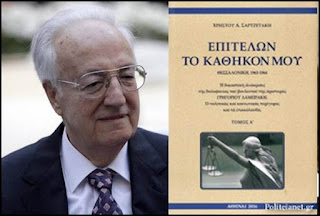
In Doing My Duty (Επιτελών το καθήκον μου), Sartzetakis advances a rigidly anti-communist interpretation of modern Greek history. He refers to the Civil War as a “bandit war” and insists:
“The threat against our homeland and its national integrity had not ceased with the military defeat of the armed rebellion.”⁷
On Makronisos, where political prisoners were tortured and killed, Sartzetakis minimizes state responsibility, describing events as clashes rather than systematic abuse.
What is most striking, however, is what he never mentions.
Nowhere does he acknowledge:
- the Bloody Wedding as a massacre of civilians,
- the terror inflicted upon Macedonian-speaking villages,
- the suppression of language and identity,
- or the forced assimilation that followed.
Silence becomes ideology.
From Violence to “National Normality”
The logic is consistent. Just as Sartzetakis legitimizes post-war repression of communists, he accepts the erasure of Macedonians as historically necessary.
Lithoxou summarizes this transformation succinctly:
“Assimilation is presented not as coercion, but as salvation; not as violence, but as national duty.”⁸
Thus, the suffering of Zelenich—and of Sartzetakis’ own maternal community—is reduced to a footnote in a narrative of national progress.
The Moral and Historical Contradiction
This contradiction lies at the heart of Sartzetakis’ legacy.
He resisted authoritarian pressure when it threatened judicial independence, yet embraced authoritarian historical narratives when they erased entire populations.
His acceptance of his mother’s assimilation—and the silencing of Zelenich’s trauma—is not accidental. It is a political stance, aligned with a state project that required Macedonians to disappear as historical subjects in order for the national narrative to remain intact.
Conclusion
Christos Sartzetakis was not merely an anti-communist jurist.
He was a custodian of a national narrative built on selective memory.
That narrative demanded silence.
And within that silence, he placed his own mother, her relatives, and the village of Zelenič.
Sources and Footnotes
- Karavitis, I. (1994). Ο Μακεδονικός Αγών: Απομνημονεύματα [The Macedonian Struggle: Memoirs] (Vol. 1). Athens, Greece: Petsivas.
https://www.politeianet.gr/el/products/ioannhs-karabiths-athhna-o-makedonikos-agon-ditomo-apomnhmonefmata - Vakalopoulos, K. A. (1987). Μακεδονικός αγώνας (1904–1908): Η ένοπλη φάση [The Macedonian Struggle (1904–1908): The armed phase]. Thessaloniki, Greece: Barbounakis.
https://metabook.gr/books/makedonikos-aghwnas-i-enopli-fasi-1904-1908-konstantinos-a-bakalopoylos-53206 - Austro-Hungarian Empire. (1904). Consular reports from Monastir, 1904–1905 (Haus-, Hof- und Staatsarchiv, Politisches Archiv, PA XXXVIII, Konsulate, Faszikel 394). Vienna, Austria: Austrian State Archives.
https://archivinformationssystem.at/detail.aspx?ID=2012716 - Lithoxou, D. (n.d.). Ελληνικός αντιμακεδονικός αγώνας [Greek anti-Macedonian struggle]. Athens, Greece: Batavia.
https://www.lithoksou.net/2020/11/makedonikos-agonas-1.html - Kleidis, K. (1984). Με τη λάμψη στα μάτια [With the glow in the eyes]. Athens, Greece: Iridanos.
https://www.politeianet.gr/el/products/kostas-kleidhs-hridanos-me-th-lampsh-sta-matia - πιτελών(book title) [Photograph]. (2026, February 3). http://vathikokkino.gr/archives/194381?fbclid=Iwb21leAPvLsZjbGNrA-8uvGV4dG4DYWVtAjExAHNydGMGYXBwX2lkDDM1MDY4NTUzMTcyOAABHpT8k4uCTdGbNmPULuo8Ad4BC5AJ9_HsZtSDGixn7vXOO6sS48iyfteuqdmi_aem_qwjqMgj0PULuo8Ad4BC5AJ9_HsZtSDGixn7vXOO6sS48iyfteuqdmi_aem_qwjqMgj0GAB6MLCrrSqURQ
- Oikonomou, P. P. (n.d.). Τα Ασπρόγεια (Στρέμπενο): Η προσφορά του κι οι θυσίες του [Asprogeia (Strebeno): Its contribution and sacrifices]. Greece: Author.
https://catalogue.kozlib.gr/vufind/Author/Home?author=%CE%9F%CE%B9%CE%BA%CE%BF%CE%BD%CF%8C%CE%BC%CE%BF%CF%85%2C+%CE%A0%CE%B1%CE%BD%CF%84%CE%B5%CE%BB%CE%AE%CF%82+%CE%A0. - Sartzetakis, C. (2016). Επιτελών το καθήκον μου, Θεσσαλονίκη 1963–1964 [Doing my duty, Thessaloniki 1963–1964] (Vol. 2). Athens, Greece: Ekdoseis Kerkyra.
https://www.ekdoseiskerkyra.gr/%CE%B5%CF%80%CE%B9%CF%84%CE%B5%CE%BB%CF%89%CE%BD-%CF%84%CE%BF-%CE%BA%CE%B1%CE%B8%CE%B7%CE%BA%CE%BF%CE%BD-%CE%BC%CE%BF%CF%85/ - Lithoxou, D. (n.d.). Ελληνικός αντιμακεδονικός αγώνας [Greek anti-Macedonian struggle]. Athens, Greece: Batavia.
https://www.protoporia.gr/lithoksoou-dimitris-ellinikos-antimakedonikos-agonas-277028.html
 Sklithro-Zelenich-Sebalći