
At the dawn of the century,
In a small and humble village,
In the heart of winter’s cold,
A baby came into the world.
Three Fates had descended there
To write the child’s destiny,
And before the morning came,
Her future had been sealed.
They wrote a sorrowful fate,
Though the child bore no blame,
A burden bound to follow her
Forever, without escape.
She never knew her father,
For he had already died—
Bandits had killed him cruelly
Shortly before her birth.
Her mother owned no cradle,
Nor even hope to keep;
Her swaddling cloth was tattered,
She slept upon bare tiles.
Her mother died as well
When she was seven months old;
Her grandmother then raised her
Until she turned seven years.
But the grandmother also died,
Struck by sickness in the lungs,
And in the narrow alleyways
She wandered without compassion.
No one chose to care for her
Or gather her to safety—
Only those who wanted help
And work in return for bread.
Wherever she happened to be,
There she would fall asleep;
Some distant relatives at times
Would offer small assistance.
And one morning before first light,
Someone asked her to work
In exchange for just a little bread—
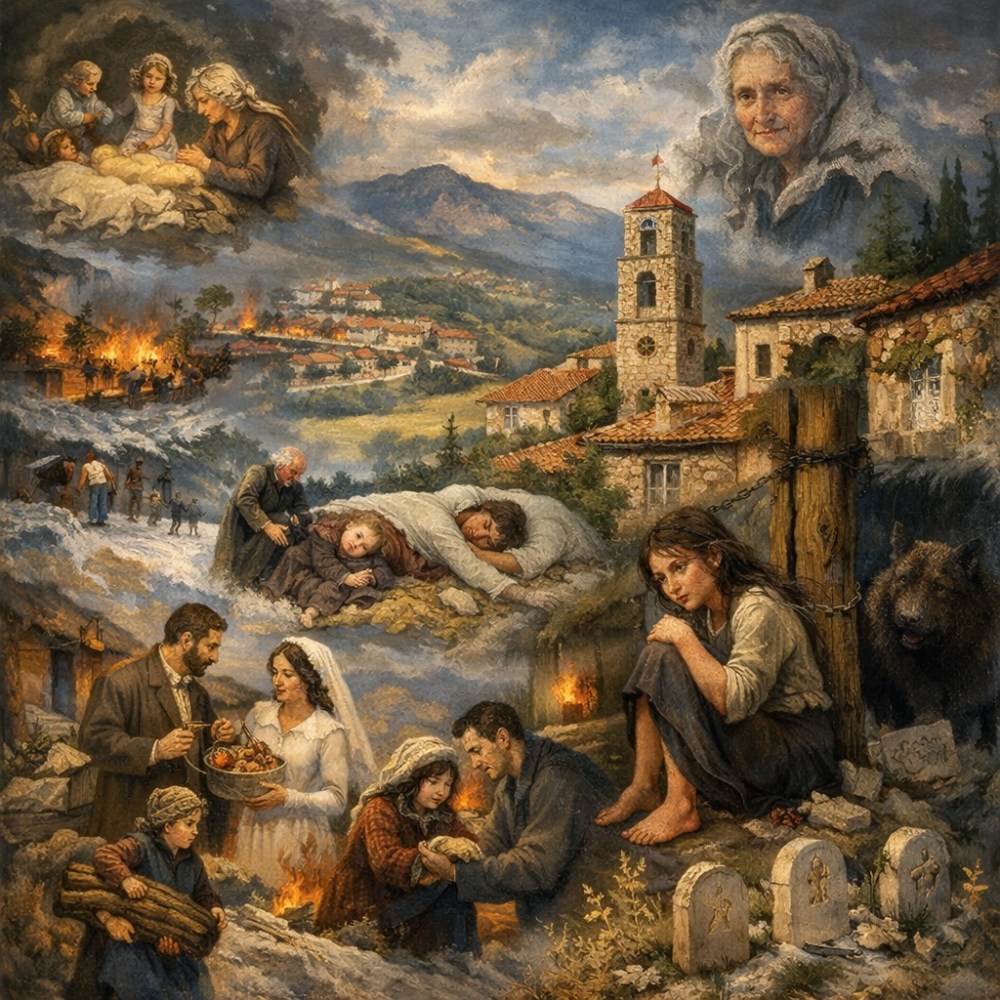
He tied her to a post,
To guard the corn through the night,
Lest a bear should wander near
And cause disturbance and fear;
That alone would be her task.
As darkness covered the earth,
Terror seized the little girl.
A villager heard her cries
And ran to rescue her.
And so, through countless sufferings,
Like walking Golgotha’s road,
Little Paraskevoula
Was later asked in marriage.
A young man from her village
Asked that they be wed;
She knew him well already,
And he knew her too.
Little Paraskevoula tried
With all her heart and soul
To become a worthy housewife,
Though she knew so very little.
But secretly, an unseen hand,
Careful not to be seen,
Would throw into the cooking pot
A hidden handful of salt.
Her husband came home from work,
They ate out on the balcony—
“What kind of food is this?” he cried,
And beat her mercilessly.
“Oh my poor dear child,
What kind of bride is she?
She neither knows how to labor
Nor even how to cook.”
Some years passed by,
And six children were born;
Yet three among them
Died while still very young.
War, hunger, and suffering
Spread across the village;
The men fled to the mountains,
The mothers stayed with children.
She left her sick child behind
With little Vasiliki
Until she returned from her wandering—
But Mitsos died in her arms.
And young Vasiliki,
Who lost her little brother,
Still remembers and mourns,
Believing she was to blame.
The mother ran like a madwoman
Through neighboring villages
Seeking just a little bread
To feed her hungry children.
One winter night,
Returning from far away,
She lay down just to sleep;
Villagers found her at dawn.
It was a miracle she survived,
Yet her hands were frozen;
Her nails were falling away,
Her lips had grown numb.
The next morning at first light,
Eight-year-old Vasiliki
Rose before the break of day
To knead the bread herself.
As if all this were not enough,
After so many sufferings,
The entire village burned
And turned to ash.
Animals, crops, and glassware—
Nothing could be saved;
Only those with little children
Were allowed to escape.
Within her warm embrace
She told me of her hardships,
And before I grow old and forget,
I wish to leave her memory behind.
She told me classic fairy tales
That all children come to hear;
Without schooling or letters,
She still knew many things.
This is the life story
Of Granny Patsis — the orphan.
 Sklithro-Zelenich-Sebalći