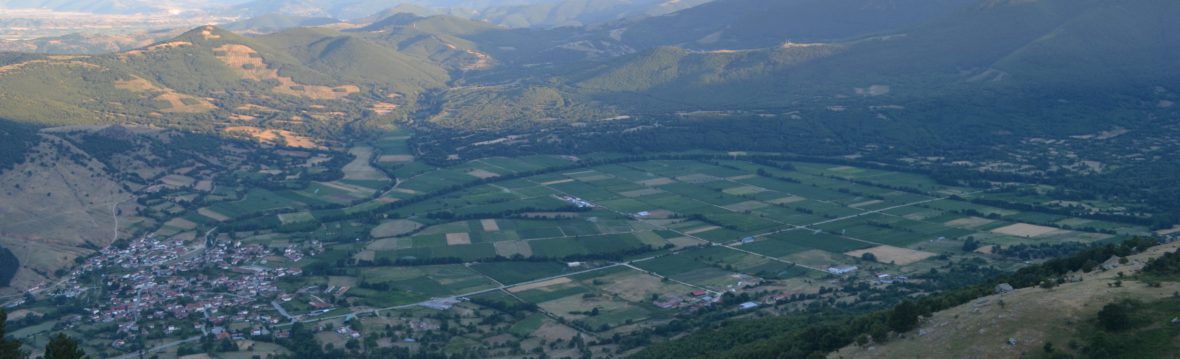

The cult of Saint Parascheva spread in the 14th century from Macedonia northwards. This was before the Ottoman invasion. One can assume that Saint Friday may have been the patron saint of the first inhabitants that settled in the Sklithro-Zelenic area after leaving the Sebaltsi location by Lake Zazari after 1396.
Saint Paraskeva of the Balkans (Petka) for Orthodox Christians is known as the protector of women, the sick and the poor. Believers turn to prayer for help and safety from a disease and other life troubles. The cult of St. Petka has been cultivated for centuries in South East Europe.
Near St. Petka temples can often be found mineral springs that people drink from, believing that it will heal their wounds and protect them from diseases.
According to oral memory, there were two celebration for St. Friday (Sv. Petka), first in April one week after Easter and the second in August. Goddess of the pagans, Saint Petka’s healing energies are ascribed to holy wells and springs throughout Macedonia, and especially in the village of Sklithro-Zelenic. Many legends exist about the origins of the spring, whereupon the healing waters ushered forth from the earth also show a devotion to Christ.
As a weaver, Saint Petka in Macedonian lore has dominion over the women’s-only fibre arts of wool carding and thread spinning and weaving. On her feast day, however, village oral history stated that one must not engage in those activities lest she punish the household. It’s customary to offer the ritual food before her icon at the family altar–the same ritual food offered to the ancestral dead, which has one thinking Petka is a guardian of the female ancestral line known to pre-Christian Teutonic cultures.
Women of the village were not allowed to do any housework other than cooking, the men were out on the fields tending to their crops. The feast day of the Life-giving Spring is celebrated on Bright Friday in the Orthodox Church and in those Eastern Catholic Churches which follow the Byzantine Rite.
Zelenich: The miracle of finding the image of the Life Giving Spring
As every year, on the first Friday after Easter, the festival of the “Life Giving Spring” (Zoodochos Pigi) would in Sklithro-Zelenich. The story of finding the icon of Zoodochos Pigi begins in the period 1840-1870 when Efterpi, a resident of the village, saw the Virgin Mary in a vision. Efterpi’s mother after she got married could not have children for many years and begged the Virgin to give her one, even giving a promise to the Virgin that if she later wanted to dedicate her life to God, she would not object.
Her prayers were answered. and after a few years Efterpi was born. When she reached the age of marriage, Efterpi married a consul in the neighboring village of Asprogeia, but the day after her wedding she returned to Sklithro to her paternal home after she refused to sleep with her husband. Her parents considered it a shame that their daughter left her husband, with her father insisting on returning to her husband. But her mother, as she always remembered the promise she had made to the Virgin Mary, did not insist because she believed that it was God’s will.
A few years later, Efterpi sees the first vision: a very beautiful and sweet woman as she described, to ask her to visit her because everyone had forgotten her and she could no longer be alone! Efterpi, after confessing this vision to her mother, advised her not to say it anywhere because they would think she was crazy after she had previously divorced her husband.
Efterpi obeyed, but for the second time she saw this female figure in a vision who complained that she did not go to find her, even indicating the place where she would find her. Again, Efterpi did not go since her sister prevented her. However, the Virgin Mary appeared for the third time in Efterpi with the threat that if she did not go to find her, this time too she would find her very bad.
Efterpi, determined to go and while no one from her family followed her in this madness as they used to say, took a Turkish boy aged 10-12 as an assistant and digging in the place indicated by the Virgin Mary through the visions, they found the image of St. Friday (Sveta Petka-Agia Paraskevi) which at the same time started gushing holy water.
There she built a small chapel with stones and placed a small chandelier. From that day until the end of her life, Efterpi dedicated her life to the Virgin Mary, going daily to the chapel to light the candle she made herself. This miracle was learned in the whole surrounding area, with the result that many people arrived in Sklithro to pray and be sanctified by the miraculous image.
In 1959, while Sklithro was still the capital of the area, the priest of the village, Dimitrios Papadimitriou, seeing the worship of the people, asked Dimitris Tsimeropoulos, who had a vineyard under the church, to give it to them so that they could build a bigger one. The god-fearing man without a second thought gave up his field and so the chapel of Agia Paraskevi was built where in the front part was placed the icon of the Life Giving Spring (Zoodochos Pigi and Agiasma), being a protector for all the inhabitants of Sklithro who now celebrate it twice! ”
Click to View pictures of St. Friday – Life Giving Spring
Sources:
Misirli, V. E. (2020, April 24). Σκλήθρο: Το θαύμα της ανευρέσεως της εικόνας της Ζωοδόχου Πηγής. LehovoNEWS24.gr. https://www.lehovonews24.gr/sklithro-to-thavma-tis-anevreseos-tis-ikonas-tis-zoodochou-pigis/
Σκλήθρο: Το θαύμα της ανευρέσεως της εικόνας της Ζωοδόχου Πηγής. (2020, April 24). LehovoNEWS24.gr. https://www.lehovonews24.gr/sklithro-to-thavma-tis-anevreseos-tis-ikonas-tis-zoodochou-pigis/
The feast day of Sveta Petka: The “Saint Friday” of Eastern Orthodoxy. (2017, October 27). amor et mortem. https://amoretmortem.wordpress.com/2017/10/27/the-feast-day-of-sveta-petka-the-saint-friday-of-eastern-orthodoxy/
 Sklithro-Zelenich-Sebalći